
Greg Kinnear on Acting, AI, and Why Movies Still Matter
Special | 27m 33sVideo has Closed Captions
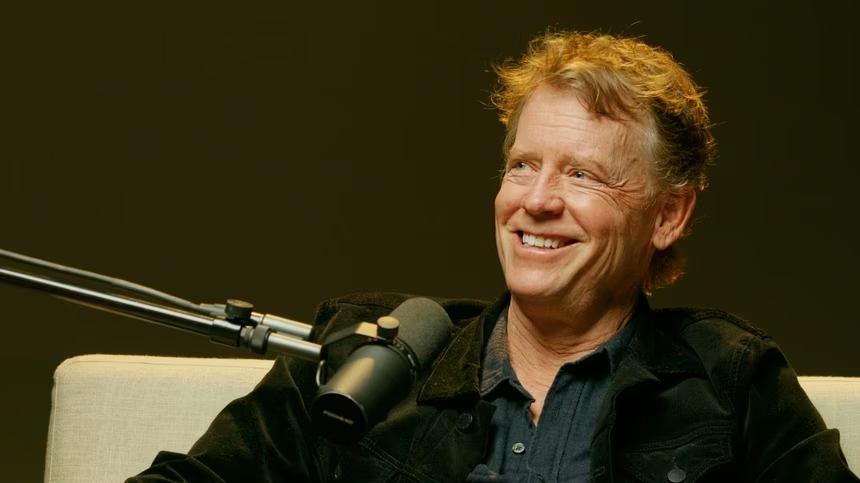
Oscar-nominated actor Greg Kinnear shares some "big thoughts."
In this episode, Greg Kinnear reflects on his circuitous path from radio and talk shows to becoming one of Hollywood’s most recognizable actors. He explains why he believes that same path may no longer exist in today’s entertainment industry. Kinnear shares why he still believes there’s something fundamentally human about great acting that technology can’t replicate.
Problems playing video? | Closed Captioning Feedback
Problems playing video? | Closed Captioning Feedback
Support for American Masters is provided by AARP, The Rosalind P. Walter Foundation, Thea Petschek Iervolino Foundation, Burton P. and Judith B. Resnick Foundation, The Philip and Janice Levin Foundation,...
Support provided by:

Greg Kinnear on Acting, AI, and Why Movies Still Matter
Special | 27m 33sVideo has Closed Captions
In this episode, Greg Kinnear reflects on his circuitous path from radio and talk shows to becoming one of Hollywood’s most recognizable actors. He explains why he believes that same path may no longer exist in today’s entertainment industry. Kinnear shares why he still believes there’s something fundamentally human about great acting that technology can’t replicate.
Problems playing video? | Closed Captioning Feedback
Where to Watch American Masters
American Masters is available to stream on pbs.org and the PBS app.
Buy Now
A front row seat to the creative process
How do today’s masters create their art? Each episode an artist reveals how they brought their creative work to life. Hear from artists across disciplines, like comedian Chris Fleming, actor Greg Kinnear, sports journalist Taylor Rooks, and more on our video podcast "American Masters: Creative Spark."Providing Support for PBS.org
Learn Moreabout PBS online sponsorshipMore from This Collection
How do today’s masters create their art? "Creative Spark" presents narrative interviews that go in-depth with an iconic artist about the creation of a single work. Each episode offers a unique window into the world of art and the creative process of artists and cultural icons across a wide range of disciplines, from music and comedy to poetry and film.
Mike Faist Embraces the Unknown
Video has Closed Captions
Actor Mike Faist explores the creative process behind his work on East of Eden. (44m)

The Many Passions of Matteo Lane
Video has Closed Captions
Comedian Matteo Lane on stand-up, painting, singing, performing on Broadway and much more. (55m 8s)
Michael Sarnoski: What Robin Hood and Folklore Tell Us About Ourselves Today
Video has Closed Captions
Filmmaker Michael Sarnoski breaks down his revisionist version of the Robin Hood story. (28m 4s)
Tyler James Williams on 30 Years of Acting and Protecting the Next Generation
Video has Closed Captions
Actor Tyler James Williams talks about his acting process and what drives his work. (35m 23s)
Why Atsuko Okatsuka’s Comedy Connects Across Cultures
Video has Closed Captions
Comedian Atsuko Okatsuka returns to the show to talk about her creative process. (30m)
Chris Fleming Embraces the Chaos
Video has Closed Captions
Comedian Chris Fleming talks about the process behind his iconic manic stage persona. (39m 17s)
How Leslie Jones Became a Comedian
Video has Closed Captions
Comedian and actress Leslie Jones does a deep dive on her creative process. (31m)
Phoebe Robinson Shows Her Work
Video has Closed Captions
Comedian Phoebe Robinson takes on hustle-culture in biting comedy special. (31m 45s)
Sarah McLachlan: Making Music to Connect and Heal
Video has Closed Captions
Singer-songwriter Sarah McLachlan opens up in a candid interview about making music. (37m 19s)
How Natasha Rothwell’s Life Brought Her to “The White Lotus”
Video has Closed Captions
Actress Natasha Rothwell on her creative process in "The White Lotus." (33m 40s)
Daniel Dae Kim Leads Spy Drama and Fights for Industry Change
Video has Closed Captions
Actor Daniel Dae Kim on his groundbreaking career and new project, "Butterfly." (21m 48s)
Phil Rosenthal’s Secret Recipe: Good Food and a Laugh
Video has Closed Captions
TV writer and host Phil Rosenthal talks about finding our shared humanity in food and comedy. (22m 53s)
Providing Support for PBS.org
Learn Moreabout PBS online sponsorship- Naturally then, does that mean everyone's an actor now?
- I think everyone has always been an actor to some degree.
How often are you completely removed from trying to performatively express yourself?
Goodness gracious you didn't know you're gonna be talking to like Salvador Dali in here today, did you?
I got some big thoughts.
Must be jacked up on coffee or something.
(pleasant music) - This is American Masters Creative Spark, and I'm your host Joe Skinner.
And our guest today is Greg Kinnear, the Oscar nominated actor joined us to talk about his most recent work in "Margo's Got Money Troubles," his instinctual creative process, the threat of AI in Hollywood, and his circuitous path to getting there.
(gentle music) How have you brought experiences from being a talk show host into acting?
- Yeah, it's funny.
I did do that.
That kind of was my early formative life, was more just kind of hosting stuff and did some interview shows and people don't remember.
I did a talk show, believe it or not, on NBC, in the wee small hours of the morning.
So I don't know, you know, all I can say is, you know, when I was younger, I guess I had, I definitely, you know, did, I was a bit of a theater kid, I guess in high school.
I was in Greece.
My dad was with the American Embassy, so I was over there for "Strangely Enough" and did some theater over there and a radio show.
But when I came out to LA you know, I kind of fell into more of a broadcasting type thing.
Low budget cable company and just kind of goofing around and doing intros and extros from shows.
And that led to other stuff.
And it really was though kind of the foundation of where I was for, you know, I didn't act really at a movie, I don't think till it was a decade in.
And I would say that the only thing it really informed was just a familiarity, maybe a comfort with cameras, maybe just the idea of being peered at while you're doing your thing.
You know, there is something odd about that.
I'm not sure it's true anymore.
I mean, my kids, you know, everybody's grown up with a phone pointing at them.
I really do believe that we've all kind of exercised the awkward intimidation of a camera.
I think we've built a generation, they don't think twice about it.
And then of course, the talk show era "Talk Soup" came along and everybody was very kind of artificially mad and they were gonna get in a fight on stage and Jerry Springer was gonna ask questions, and then there was that kind of artificial, we are comfortable with a camera.
And then now, I don't know, I just think everybody's kind of gotten used to it.
So, you know, for me, I guess it was just an ease of that early on, kind of, kind of helped grease the wheel so that when I did finally start acting and I did get an opportunity, I wasn't thinking about being watched.
I wasn't as self-conscious about that as much as I might have otherwise been.
- Yeah 'cause I guess with screen acting in particular, you need to be very technically aware as well that there are cameras around you, right?
- Yeah I mean, I know there's, I think, six cameras on us right now.
- Good eye.
- How about that?
- Good eye.
- That's with me staring at you, Joe.
And not looking in 1, 2, 3.
- That's great peripheral vision.
- There's gotta be another one around here.
But I mean, you know, you do kind of get some sort of awareness and some sort of yeah peripheral sense of that.
And there is, I think Michael Kane talked about it a lot.
There is very, you know, technical side of that, but I don't think ultimately it's your friend.
You know, you're trying to be in the moment and live in the moment.
So as much as you can make all of that disappear and not be counting them, it's probably better.
- Yeah.
Well it's interesting what you're saying too.
I mean, it's true.
In the early nineties, not everybody had a camera pointing at themselves all the time.
I mean, it's a very different era we're in now.
- It was starting then.
I remember being keenly aware, you know, looking around the landscape and realizing, oh my God, all the cameras used to be kept in these little stone walls of these studios.
That's where we had cameras and that's where we had people.
But that all changed and it changed so quickly.
I don't even know whether you'd say it was eighties or nineties, but suddenly Sony got in the game and everybody had a handheld recorder and was shooting stuff.
And I remember thinking, my God, can you imagine some of the crazy (audio beeps) that's being filmed right now, but we don't know about, and it was probably also informed by talk suit because that, you know, we got some unusual footage that was sent in of things where you were like, this can only happen by accident.
- Naturally then does that mean everyone's an actor now?
Everyone could be an actor or?
- I don't know, I guess we, I think everyone has always been an actor to some degree.
But, you know, it's, you know, we're all masking up to some degree and everything is, you know, performance.
There is performance oriented in all things.
I mean, you know, how often are you completely removed from trying to performatively express yourself?
And goodness gracious, you didn't know you're gonna be talking to like Salvador Dali in here today did you?
Meet Stanley Kubrick.
I got some big thoughts.
Must be jacked up on coffee or something.
It is true though.
I do think that, you know, there's no way that it hasn't changed.
There's no way if you flip through like the Instagrammy and Insta posts or whatever that thing is, in all of the feeds of people, and I don't have any footprint on that, damn I'd be good.
But I definitely, by the way, if you see me out there, it's not me.
I don't put anything out there.
- So the real Greg Kinnear's not- - The real Greg Kinnear is not the real Greg Kinnear.
I'm here to tell to you right now, fraud.
But I do peek around and I do see that stuff and I'm like, wow, this is, , I'm just always amazed at the ease and the comfort of the person standing in front of their phone, because that's a camera.
(gentle music) - Many of Greg Kinnear most iconic performances feature him as a kindhearted man with an undercurrent of cynicism or desperation.
There's clearly connective tissue between his work in "As Good As It Gets," "You've got Mail," "Little Miss Sunshine," and now "Margo's Got Money Troubles" where he plays Kenny, a square youth minister who serves as a foil to the edge of your characters on the show.
Are you often finding yourself connecting with a certain kind of character?
- No, I mean, like, certainly there's been roles or moments where I'm like, there's a sharper edge on this performance, on what would be the performance in this piece than might otherwise be.
I like not to think that, "Oh, this is nothing.
I phone that in."
But there are elements where, you know, the character is, you know, I think characters are just sometimes, you know, there to kind of help tell the story and help, and you do it the best you can and you're in your wardrobe and you've got your moments and you're thinking through about how best to project that.
But I think at other times, you know, and it happens, I don't think it always happens.
It's just sometimes the script lines up in a way where you're like, wow, this is really sharp.
This really has an edge on it.
Really sharp character and a really pointed director as well.
And cast just all of the elements come together that kind of help you feel like, oh, this is really, I sometimes feel like I'm further out on the end of the plank than I other times am.
And certainly with "Margo's Got Money Trouble," I mean, Kenny was like, yeah, it's a really fun character and he's, I mean, way over his head.
But I loved the sensibility of the guy and trying to project him as, you know, somebody who was deeply in love with Cheyenne, you know, Michelle Pfeiffer's character and kind of really trying to, you know, play that earnestly but not make it a joke and try to find a fun line there because it is funny, but it's also, there's some loss there for this guy too.
You know, something's happening that he's not aware of.
That's kind of unfair to him in a way.
And I think that's kind of interesting.
- I had an acting class once in college, I went to film school and the teacher said that when you're approaching a character, you need to always approach the character from a position of love for the character and not thinking about it as a villain per se, if it was a villain, for example.
So I guess I'm curious, you know, are you generally thinking about your characters from a position of sympathy always?
- Yeah.
I mean, you hear that.
I mean, I guess I really didn't have, you know, do a lot of acting classes.
Don't say it "That's obvious, Greg," I knew you were gonna say it, but just I'm cutting you off.
But I definitely, I have heard that before and I've read that and I, you know, and I find it, I guess it's true.
I mean, I guess I've played, you know, some bad guys, some pretty despicable people too.
And you know, at the end of the day you're not unaware that what they're doing isn't perhaps good behavior.
But I do think that if you can be neutral about that or yes, more, you know, share in what they think, which is, you know, a bad guy never wakes up thinking he's a bad guy.
It's probably, probably helpful.
I mean, listen, I honestly, for me, it's this more, I always feel like it's just kind of a feeling and instinct on whatever it is I'm doing and kind of go with that.
- You know, our show is called Creative Sparks, so it's thinking about that initial thing that gave you that spark to create and to act in this case.
So when you were little and you were younger in Indiana or living abroad, what was the first kind of formative moment for you in the theater experience?
- I think I ended, I was on some stage in Indiana and my mom put me into some production where they needed a kid.
And, you know, I had to come out and say a line and I don't know, Julius Caesar or something, and I was, it was nothing.
It was literally, they needed a kid.
It was almost like a prop.
And I remember that happening at some point in my life.
But what I was way more interested in is they were very clear about not going out in front of the curtain prior to the show starting.
And my kind of, you know, the better angels and me not being able to control that urge and walking around the curtain and coming out and the applause started because people thought the show was starting.
And then I was quickly, a hand pulled me back behind the curtain, but I remember thinking, "Hey, that was kind of a nice hit there.
Anybody else feel that?"
You know, I had a radio show in Greece, a weekly radio show, which probably did more for my curiosity about kind of entertainment, I guess, in a way than anything.
And it was really just, I was on after Casey Kasem, American Top 40, and I came out and did, you know, an hour show and it was just not really great.
(both laughing) Not really, I mean, talk about what was going on at school, spin some records, play The Knack or whoever the hell was happening at the time.
But I remember thinking, you know, getting a lot of feedback at school from people.
I just knew that they were starting to listen to this show.
And I remember thinking, oh, that's interesting.
You really can build an audience.
I've not been great at building audiences since then, but I started strong.
- And why do you think that built your curiosity more than the stage at the time when you were younger?
- Probably lack of other options to some degree.
For me, I felt like it was a, you know, to some degree, this is not to say I'm a natural 'cause I am not, but it comes more naturally to me than say, computer science or, you know, selling insurance policies or home spas.
It just, you know, I felt like it was, you know, fluid.
And I trusted myself in, you know, if I kind of trusted myself in terms of being, you know, if I had to do something on camera, I just was like, oh, I can do this.
Not always very, you know, different degrees of confidence, but I always felt like I can do this, whereas God help me if I ever had to have a real job in the real world.
Can you imagine?
Okay, well it seems you haven't, so your Verizon bill last month has dropped 10%, so we are helping you.
However, I see what you are concerned about as a customer, and I think we can improve on this bill for you, Joe.
We're gonna let me talk to the back office and see.
- You would be a charming rep.
- I wouldn't have been bad.
Now I think about it.
I probably missed my calling.
- So it sounds like you're leaning into your strengths, essentially.
It sounds like.
- Well, I don't know.
I mean, like what I thought my strengths were or what I believed them to be.
And I also, you know, none of this is to say that I don't love it.
I have, I really do.
And I have, you know, it's a great, it's, you know, very Sammy Davis Jr.
Very lucky opportunity to ever be able to find your way through whatever happenstance.
And my God, you've talked to people, it's always such a Rolodex of insanity in terms of how people get to end up making a professional career out of anything in this kind of ecosystem.
And I feel very lucky to have found it because I do enjoy it, and I do, I genuinely would need an outlet like this, even if I weren't doing it professionally.
I would need some outlet like this.
I don't know what it would lead to.
I don't know if it would be doing local theater or whether I'd go and, you know, do Standup Night at Chuckles or what, but I would need something.
(gentle music) - What do you think is the value of arts and entertainment, just broadly speaking?
- It's created love.
Like I've watched a lot of, I've fallen in love in movies, you know, with people, you know, and moments and places.
I really feel that, you know, when it's really executed well but the truth is, you know, it's a thing to watch something.
It's a thing you have to check in.
And I know this binge thing, "Hey, hey," I don't know where people have all this time.
First of all, I don't know where this is coming from.
Some sort of third rail parallel world where people are able to constantly be downloading and watching and seeing and viewing, and I've just always been chasing time, I feel like.
So for me to like sit down and really focus on something takes time.
And I do think that's the joy of a movie screen and a movie theater, even though I don't feel like the movie business feels very healthy right now.
It's the great place where you go and hopefully turn off your phone and silence it and hope, you know, you go in and you focus and you get to watch it and have an experience, you know, when that really works, when you're really having that experience, it's fantastic.
- The industry is in this moment of tumult, I guess, or transition, whatever you want to call it.
What do you kind of project for the future of acting in this business?
- Well, I'm pretty bullish about acting actually.
- I think that acting will survive all of the craziness that we're in.
And I don't know what's to come for AI, but acting will be around, and I feel very sure of that, that a non-synthetic humanoid will continue to be able to project and do things to make people feel and understand and open their eyes to things.
So I'm bullish about that, but if I'm being completely transparent, I don't know, like I think, you know, the me that arrived here, you know, 30 years ago, probably much less likely to be able to, you know, make a living in this business.
And that is a bigger issue.
I think that is very concerning.
You know, I feel like that that area of, you know, it's the lower middle class, middle class world that we talk about in the economy is also present in the, you know, the acting world and in the sag after world.
And I feel like that area has been gutted.
It's no secret.
I mean, you know, that's really in a crisis mode right now.
And, you know, I don't know, I think there's, you know, fewer jobs, fewer opportunities.
It's, you know, it's for sure, it's a pretty bleak time.
I think since the, since COVID since the strike, I feel like there's been a, you know, people have talked about a reset, and there's no question the studios are making less product.
It seems like there are strains on the movie business.
It seems like, you know, the golden age of television is slightly been slowed down.
And because in terms of the amount of volume, production has left Los Angeles, it's moving not only outside of Los Angeles, it used to be other states, now it's moving internationally.
If you want to go shooting hungry man, great opportunities, hard to raise a family.
And the whole business was kind of built and predicated on this idea that we were a big carny tent here.
Didn't mean we didn't go outside, but you could actually raise your family and kind of have some existence here.
And I kind of feel like that has been, that's cracked, the seal's been cracked on that.
And I, you know, it's kind of heartbreaking.
At least the timing that I've been here from when I arrived to where we're at now is pretty alarming.
So I'm all for pendulums and I'm all for pendulums, swinging back.
I don't think it's hopeless.
I think there are people paying attention to that issue who are gonna try to, you know, who are trying to right the ship.
But I do think that you let the genie out of the bottle and it's hard to put the toothpaste back in it.
Now.
I know what you're thinking, can't mix those two.
You can, Joe and I did.
We'll see.
- I always see the arts as a respite from our AI overlords, the dangers of AI.
I mean, I'm curious if you too see the arts and entertainment as something quintessentially human if there's, I like to think that it's sort of a defense against our synthetic futures or our AI futures.
- Yeah, well, I certainly like the idea, that sounds great when you say it, I'm all in.
And so is everybody else watching.
Hey, that's, there you go.
But is that really impervious to attack?
I don't know.
I mean, like, it's pretty, pretty shocking when you see kind of what's being baked up in the back of the laboratory.
And I've not been back in the laboratory.
I feel like everybody knows a guy who's been back in the back of the laboratory and it comes out going, "Oh, (audio beeps) this is really bad."
But I don't know that guy.
And I don't know, you know, but I don't exactly know that it's true, but I do know something for sure wicked this way comes, and that it is, we've seen enough just as a casual processor of what you're seeing out there.
We know, you know, it's real.
And I kind of, I think I saw Matthew McConaughey or somebody talking about it and saying, you know, "Well, we just gotta lean into it, man."
And I was like, yeah, he's kind of right.
You're not gonna, you can't fight this.
I don't think you can fight technology.
I mean, I've just seen too much technology happening, you know, CGI, everything on from when I started, it keeps coming.
But I'm just convinced that AI can't change the fact that Christopher Walken tells you this watch was carried by a grandfather up his ass.
And does that monologue that just basically just makes us all collectively gasp.
That's just such a human thing.
I don't know how AI can compete with that in all the other little moments that you all, we all kind of collectively remember from all of these shows and movies.
I think that's gonna keep us safe for a long time.
I don't know, forever and I don't know if I'm, and I don't know the timeline.
I don't know if we're talking about weeks or months or years.
I mean, people are, yeah, I don't know.
The talk is so hysterical about it that I don't know whether I should be more hysterical about it or I'm like, you know, is that a sign that it's not really the threat that they say it is?
I don't know.
- Yeah, I mean, because you've seen a lot of these moments of hysteria in your career too.
I mean, video killed radio and here we are on video radio and... - I'm old enough to remember I had a Blockbuster card, Joe.
Okay Blockbuster video card.
- Well, to me, it sounds like, you know, despite the worries and the concerns, there's a glimmer of hope I'm reading in what you're saying about the humanness of performance and acting and the arts.
- Yeah, I think so.
I mean, I do think, and maybe it'll be performative, you know, maybe it'll be performance based, you know, maybe people are going to watch, maybe it's some hybrid, you know, people are going and, you know, I remember they built that ridiculous sphere out in Las Vegas, and I happened to be there when they were building.
I was like, well, this is gonna go out of business in a week.
And I think it's very expensive but very successful venue.
And the shows are great, but they're interactive and you're at a thing and you're watching a live performance and you're with other people and there's something going on there and theater, I told, you know, it was back in New York a few weeks ago, and my wife and I took one of our girls to see "Oh, Mary!," shout out to "Oh, Mary!"
Fantastic.
And a couple of other shows, and it was so great.
And just to feel the audience and to feel the energy of that.
So listen, that's always there.
I mean, I guess, you know, certainly concert venues are up, so maybe live performance starts to play a bigger role, but performance by people is something that has kind of risen above everything in that they've thrown at us technology wise over the millennial.
So I still have, yes, some hope.
(gentle music) - [Joe] That's our show.
A big thank you to Craig Kinnear for taking the time to talk.
American Masters' Creative Spark is a production of the WNET Group.
Media made possible by all of you.
This episode was produced by me, Joe Skinner.
Our executive producer is Michael Kantor.
Original music is composed by Hannis Brown.
This episode was mixed and mastered by Jon Berman.
Funding for American Masters" Creative Spark is provided by The Rosalind P. Walter Foundation, The Anderson Family Charitable Fund, The Marc Haas Foundation, Sue and Edgar Wachenheim III, The Charina Endowment Fund, The Ambrose Monell Foundation, The Kate W Cassidy Foundation, The Philip and Janice Levin Foundation, and by PBS viewers like you.
Thanks, see you soon.
(gentle music)










Support for PBS provided by:
Support for American Masters is provided by AARP, The Rosalind P. Walter Foundation, Thea Petschek Iervolino Foundation, Burton P. and Judith B. Resnick Foundation, The Philip and Janice Levin Foundation,...