
NC Weekend: America250 Celebration
Season 23 Episode 26 | 26m 46sVideo has Closed Captions
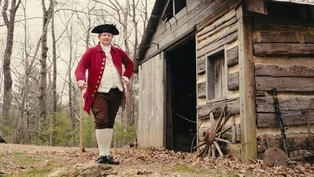
Mark America’s 250th anniversary by exploring Revolutionary sites across the state.
In honor of America’s 250th anniversary, we explore Revolutionary sites across the state, walking the same paths taken by patriot soldiers and their families. Join us as we travel through time from prehistoric landscapes that fueled the British Navy and a frontier town shaped by a medieval reformer, to an augmented reality experience that brings Revolutionary battlefields to life.
Problems playing video? | Closed Captioning Feedback
Problems playing video? | Closed Captioning Feedback
North Carolina Weekend is a local public television program presented by PBS NC
NC Weekend: America250 Celebration
Season 23 Episode 26 | 26m 46sVideo has Closed Captions
In honor of America’s 250th anniversary, we explore Revolutionary sites across the state, walking the same paths taken by patriot soldiers and their families. Join us as we travel through time from prehistoric landscapes that fueled the British Navy and a frontier town shaped by a medieval reformer, to an augmented reality experience that brings Revolutionary battlefields to life.
Problems playing video? | Closed Captioning Feedback
Where to Watch North Carolina Weekend
North Carolina Weekend is available to stream on pbs.org and the PBS app.
Providing Support for PBS.org
Learn Moreabout PBS online sponsorship- This program is made possible in part by generous support from the American Battlefield Trust, connecting you to the places where our nation was forged.
Visit battlefields.org today.
♪ - Next on North Carolina Weekend, we're marking America's 250th by exploring the Revolutionary War stories hiding in our own backyard.
We'll walk through a prehistoric landscape that fueled the British Navy.
Travel back 600 years to discover how a medieval reformer shaped a North Carolina frontier town and step inside the revolution through augmented reality.
Coming up next.
♪ - Funding for North Carolina Weekend is provided in part by VisitNC, dedicated to highlighting our state's natural scenic beauty, unique history, and diverse cultural attractions.
From the Blue Ridge and the Great Smoky Mountains across the Piedmont to 300 miles of Barrier Island beaches, you're invited to experience all the adventure and charm our state has to offer.
♪ - Welcome to North Carolina Weekend.
I'm Deborah Holt Noel.
We're marking the 250th anniversary of the Declaration of Independence.
And over the years, we've taken you to some of our state's Revolutionary War battlefields like Guilford Courthouse, Moores Creek, and nearby Kings Mountain.
And if you visited them, you know how powerful those places can be.
But this season, we took you to some places that we've never visited before on this program.
Tonight, we want to revisit these special places and the history that makes them worth experiencing.
Tonight, we're starting with one that might surprise you.
It doesn't look like a historic site.
In fact, it looks like it's barely changed in 300 years.
Let's begin in Brunswick County.
- If you want to know what most of coastal North Carolina looked like during the American Revolution, this is it.
A prehistoric longleaf pine savanna with carnivorous plants and incredible biodiversity.
Welcome to the Greenswamp Preserve in Brunswick County.
This incredible ecosystem once covered 92 million acres across the southeast.
Less than 5% remains.
But to understand why, you have to travel back nearly 500 years.
In 1584, English explorers wrote home that these forests contained enough tar and pitch to make their queen ruler of the seas.
They were right.
But first, Britain had a problem.
Ships don't just need wood.
They need tar and pitch to seal the hull, turpentine to treat the rigging.
And what they would do is they would take that honing tool, put a hole in to get this sap running out of the tree.
Britain called these materials "naval stores."
But in 1705, war in the Baltic cut off their Scandinavian supply and left one of the world's most powerful navies suddenly exposed.
So Parliament acted, bounties for colonial producers, sales restricted to British merchants.
It worked.
By 1768, 60% of Britain's colonial naval stores shipped through North Carolina, down the Cape Fear River, out through Brunswick town, just a few miles from where we're standing.
Today, thanks to decades of conservation work, nearly 5 million acres of longleaf pine have been restored across the southeast.
The Green Swamp Preserve is one of the finest examples, managed with controlled burning, open to the public, and free to visit.
It's a national natural landmark that's been set aside in perpetuity for protection of a whole bunch of amazing and rare species.
The preserve itself is almost 16,000 acres.
It is one of the gems in North Carolina's crown, as I've heard it put.
As part of the naval stores industry, there was a lot of harvesting of the tar and pitch from longleaf pine.
What I'm standing on here is a tar kiln, and you can see this ditch that I've kind of dug.
It's a circle all the way around.
And so all that tar eventually, over the course of like nine, 10 days of cooking that pile, would come out and they'd collect it in those barrels.
It's a very messy job, and so the folks working it obviously got very messy as well.
And that's one of the thoughts behind why we call this the Tar Heel State.
- If you're a Tar Heel, it is a North Carolina treasure.
300 years ago, it would have covered many, many miles continuously.
Now it's broken up with golf courses, Walmarts, and housing developments.
So this preserves the longleaf pine forests and the plants and the animals that live here.
- But the trees are only part of the story.
The Green Swamp is home to 14 species of carnivorous plants.
Venus flytraps ride alongside the trail, pitcher plants, sundews.
And if you look up, you may spot a red-cockaded woodpecker.
- It is world famous for its carnivorous plants.
These are plants that live in nutrient-poor environments, sandy or acidic soils.
And so the way they get their nutrients is from catching animal prey, mostly insects.
And they have different kinds of traps, different ways of catching their prey.
And there's no place in the world that you can see a greater diversity of carnivorous plants than at this location.
- You walk out here, and you don't really see everything at face value.
It doesn't really look like that much.
But then when you really get down to the forest floor, that's where the really cool stuff is.
And once you see that micro-scale diversity, it is truly an amazing place.
- The trail runs 1.3 miles one way through Pine Savannah, Boardwalk, and Open Meadow.
Flat and accessible, but stay on the trail.
The Brunswick County Sheriff's Office has had to rescue hikers who wandered off.
The red diamonds on the trees are there for a reason.
(gentle music) - The Green Swamp Preserve is located in Brunswick County, and it's open to the public free of charge.
To learn more and plan your visit, go to nature.org/greenswamp.
The Green Swamp showed us how our natural history has shaped who we are today.
Now we're headed to the mountains, where a line drawn by a king divided more than just land.
It divided communities and loyalties.
And for decades, one mountain town has been keeping that story alive each summer.
- This is the Hickory Ridge History Museum in Boone, North Carolina.
Nestled high in the Appalachian Mountains, costumed interpreters guide visitors through recreations of daily life for the colonists who first settled this corner of the state.
- All any spinning wheel does is put twist in your fiber.
- To understand their world, you'll have to go back more than 250 years.
In 1763, King George III drew a line straight down the spine of the Appalachian Mountains, following the Eastern Continental Divide.
The settlers crossed it anyway, but they were caught between two forces, indigenous nations like the Cherokee, protecting their homelands and supported by the British Crown, and their own lust for land.
Britain had just spent a fortune fighting France and their native allies for control of their North American colonies.
So when the Seven Years' War ended, the King drew that line as a promise to make terms with those same nations.
But settlers kept coming.
The King was an ocean away, Britain's treasury was exhausted, and there were never enough troops to enforce the border.
By the time the revolution started, many colonists were already living on the wrong side of that line.
Hickory Ridge brings that world to life through six historic cabins, period interpreters, and hands-on demonstrations in the crafts that defined backcountry survival.
Hearthside cooking, blacksmithing, candle making, spinning, the self-sufficiency of a people who had no one to rely on but themselves.
- When you get here, it's like a step back into time.
All of a sudden, things, they start getting slower.
- Hide in the woods, and then you march us out here in the open.
- Our goal is to educate the public on what life was like in Western North Carolina during pretty much the American Revolutionary period.
- We really want people to be able to kind of whet their curiosity, but in a very authentic way.
- Life in the backcountry for settlers in the late 18th century was not the easiest.
Technically, everything around here was out to get you, was out to kill you, so it was a daily struggle to survive.
They don't call it the frontier for nothing.
- You get to see everything that happened from back many, many generations ago, and it's a great educational tool.
- And when the sun goes down, the story continues.
Horn in the West is one of the nation's oldest outdoor revolutionary war dramas.
Set in the years before and during the Revolution, it follows a small mountain community torn between loyalty to the crown and the fight for independence, with Daniel Boone as their guide through the wilderness.
According to the museum, since its premiere, 1.4 million people have seen this historic play.
- We've got romance, we've got battles, we've got fire, we have everything you can possibly imagine.
There's plenty for anybody to enjoy it, young and old.
- It is a full-on theatrical production that takes many hands.
It means so much that we can share what happened many years ago.
It moves you, and we would love for folks to come and enjoy and be a part.
- But both the Hickory Ridge and Horn in the West show are seasonal operations with robust summer offering, so check visitor information before planning your trip.
- When you learn about history, I think you develop a certain amount of understanding and respect for what came before you.
- Hickory Ridge History Museum is located at 591 Horn in the West Drive in Boone.
For more information and seasonal events, visit hickoryridgehistorymuseum.com.
The back country settlers of Boone weren't the only ones trying to carve out a place in an unfamiliar land, but to understand another community caught between two worlds, let's travel back to medieval Europe.
- This is historic Bethabara Park.
Today it's peaceful, fields and forests, and in the 1700s, it was one of North Carolina's most important frontier towns.
But the story of this place doesn't start here.
It begins more than 600 years ago with a man who challenged the most powerful institution in Europe.
In 1415, a Czech preacher named Jan Hus was put on trial for criticizing the Catholic Church.
When he refused to take back his beliefs, he was executed, but his ideas didn't die with him.
Instead, they spread.
For the next three centuries, some of his followers, now known as Moravians, faced generations of persecution before carrying their message across Europe and eventually across the Atlantic.
One place they chose might seem surprising today, the North Carolina back country.
In 1753, Moravians purchased nearly 100,000 acres of wilderness on the colonial frontier and named the tract Wachovia.
The first settlement here was called Bethabara, meaning "house of passage," and it thrived.
- The church has missionaries all over the world, and missionaries are great at making more Moravians, but they don't make a lot of money, and so the church also needs to find a way to fund those missions.
So they're gonna use these frontier settlements to create goods that people on the frontier will need as they spread out further west.
- But within a few decades, something else would arrive in the Carolina back country, revolution and war.
Bethabara found itself caught in the American Revolution.
The prosperous Moravian town supplied passing troops and, after the Battle of Kings Mountain, was compelled to house hundreds of loyalist prisoners.
Today, Historic Bethabara Park invites visitors to step into that history, exploring the remains of a frontier settlement shaped by faith, migration, and the challenges of the American Revolution.
- We are at Historic Bethabara Park.
This was the first Moravian settlement in this state, and we like to say the birthplace of Winston-Salem.
- If you would spin this up, it would probably make like a medium-quality linen.
Every day, we have different trades going on.
We offer pottery, blacksmithing, woodworking, textiles demonstrations, spinning.
- Open year-round from dawn to dusk, Bethabara Park invites visitors to explore 18th-century buildings and stroll through its historic medicinal garden.
- Moravians were very peaceful and very big on helping people so they would have offered help to anybody that came through.
- Through interpretive stations, you learn about topics like Moravian involvement in war, Moravian medical practices, and visitors can even take part in hands-on demonstrations of traditional Moravian trades, experiencing firsthand the skills and craftsmanship that sustained the early community.
- This corner cupboard is a great example of early Moravian craftsmanship around the time of the American Revolution, actually, so you're looking at, you know, almost 300 years old.
- The park is also adjacent to three miles of greenway trails for visitors to enjoy.
- If you want to come and you want to learn about the history, we have archaeological foundations and artifacts all over town.
We also have a visitor center with a museum area that you can come explore.
And then if you're more naturally inclined, you can explore our preserve.
- We have two historic 18th-century Moravian cemeteries, one for Moravians and one for non-Moravians who would have died in town.
- You can also experience Bethabara through guided tours or a free app with English and Spanish audio.
- As an American today, or most of us, luckily, have never had to think about what war happens to look like when it's happening in your backyard.
The Moravians would have been very aware of that.
- We're kind of like a hidden gem of the city.
Learn more about the city, learn more about the people here, and get to experience something different.
- Historic Bethabara Park is located in Winston-Salem and is open every day from dawn to dusk.
For visitor center hours and more information, visit historicbethabara.org.
The revolution we've been tracing was fought mostly by colonists who were newcomers to this land.
But for some Native Americans, this tumultuous time came to define the next chapter of their history.
Next, we visit a museum in Robeson County dedicated to preserving that story.
- For thousands of years, people have lived along these rivers in Robeson County, North Carolina.
By the time of the American Revolution, many ancestors of the Lumbee Indians were still here, and some fought in the American Revolution.
This is the Museum of the Southeast American Indian, sustained by a community that never stopped fighting for its own story.
Located on the campus of UNC Pembroke, a university originally founded to educate Lumbee children, the museum has been a center of culture and history for decades.
- Our focus is very Native-centered and community-driven, so it is an authentic experience that is uniquely curated to highlight Native community.
The tribes that we represent here are the eight tribes in North Carolina, and we include the Catawba in South Carolina.
We also stretch out further with the tribes that are located in the Southern states.
What we offer through exhibitions, public programming, and engaging opportunities are ways of understanding who are Native people of the South.
- The oldest piece in the permanent collection is a 16-foot dugout canoe pulled from the Lumber River and dated to more than 1,000 years ago.
It shares the floor with the pine cone patchwork quilt, created in the early 1900s and recognized by the National Quilt Museum for its craftsmanship.
Another favorite stop is the recreation of an 18th-century cabin that gives visitors a window into how life was once lived here during the Revolutionary War period.
- One of the unique ways that we share stories is through the people themselves, and so we've created a lot of videos, and we share those in the museum.
- We also have a museum gift store that people can come and shop at.
We have a variety of different things from pottery, beadwork, jewelry, huge selection of books.
- We also have a Children's Discovery Center, which is an intergenerational learning space where families and other community can gather and listen to a story or hop in our canoe and take a ride or even do traditional crafts.
- Rotating exhibitions of Native art from across the Southeast keep the walls alive with contemporary voices.
And throughout the year, the Life by the River program brings together the communities from across the region for workshops, storytelling, and hands-on cultural experiences.
- American Indian people were important to North Carolina society, so as the American Revolution is heating up, we were at the center of those politics as well.
So once the outbreak of the war happened, prevailingly what we see are more men that were enlisting on the patriot side.
The outcome was there was one singular nation that Native peoples would have to deal with.
Now there was an America.
- Our histories have often been overlooked, and so we want to bring forward those stories, those genealogies, the whole experience of what it means to be a Southeastern Native.
- A living museum in every sense of the word, and admission is always free.
In December 2025, the community's perseverance finally culminated in full federal recognition, 137 years after they first asked for it.
- One of the people's view on America certainly is that this is our country.
This anniversary has really provided an opportunity to be more retrospective, to look back and examine the actions of our ancestors to understand who we are today.
Most of us are very patriotic.
We are uniquely American.
Most of all, we are uniquely North Carolinians and uniquely Southern.
[upbeat music] - The Museum of the Southeast American Indian is located in Pembroke on the campus of the University of North Carolina at Pembroke.
Admission is free.
For hours and more information, visit uncp.edu/museum.
The Museum of the Southeast American Indian reminds us that the American story is older and more complicated than any single story.
Now, before we head to our final stop on this colonial tour, we have a special announcement.
Now, I've visited historic Halifax many times before.
And as you may know, America's first formal call for independence took place here in North Carolina three months before the Declaration of Independence.
It's called the Halifax Resolves.
And the only surviving copy of this historic document has finally come home.
On loan from the National Archives in Washington, D.C., the document is believed to be returning to Halifax for the first time since it was sent to the Continental Congress in Philadelphia in 1776.
It's on display in the newly redesigned Visitor Center at Halifax State Historic Site through October 6, 2026.
After that, it goes back to Washington.
Do not miss this once-in-a-250-year opportunity.
The Halifax Resolves remind us that independence was declared on paper in 1776.
But for enslaved black populations and other people of color, the story was far more complicated.
In Currituck, North Carolina, the historic Jarvisburg Colored School Museum preserves that complexity.
Their newest exhibit honors John Jasper White, an enslaved ship captain who outwitted the British during the Revolution and was later granted freedom.
He went on to own a shipping business in the same waters he was once enslaved.
To learn more about this remarkable story and others, visit the historic Jarvisburg Colored School Museum at 7302 Caratoke Highway in Jarvisburg.
For more information, visit them online at hjcschool.org.
Now, our final story tonight takes us to Charlotte, where technology meets the revolution.
- This is the American Revolution, as you've never experienced it before.
This augmented reality experience is at the Charlotte Museum of History, right here in North Carolina, also known as the Queen City.
The exhibit is called "American Revolution, the Augmented Exhibition."
Visitors use a tablet called a histopad to move through interactive portals covering the years 1763 to 1789.
- So to scan into a portal, we'll take that circle and we'll line it up.
♪ ♪ And here we are in Versailles.
- You can experience the Boston Tea Party, the crossing of the Delaware, Winter in Valley Forge, more than 20 pivotal moments in the Revolutionary Era.
- When guests come to the Charlotte Museum of History, they're gonna see our new American Revolution augmented exhibit.
And what that is is three full galleries here on the first floor of the museum, full of interactive tech that will help you experience the American Revolution.
- For generations, centuries, museums have been things in boxes and panels on walls that you read.
What myself and my team have really been focused on is reengaging the public with history, making it exciting.
We're very excited for everyone to come and see this.
- This exhibit is special for a few reasons.
Number one is the technology itself.
This stuff is really cool video game technology that really immerses you in each of the scenes.
Every scene is interactive.
You're hearing people speak.
You can literally move throughout the scene.
That is just really new technology, and we think it's really cool.
- When you walk in, you'll check in at the front desk, and you'll be handed a tablet that is called a histopad.
You'll get a demonstration on how it works, and then we send you off into the exhibit.
- If you're someone who is attracted by the cool objects or the striking pictures, you can set your journey around the visual things that stick out to you.
But if you're a panel reader and you want to know every single detail, there are over five hours of reading content available for you, and there's something for everybody in between.
There are treasure hunts.
For the kids, there are selfie stations where you can dress up like it's the 18th century.
There's all sorts of ways to interact with it.
- A lot of them have a time slider, so you can go from 250 years ago, and you can slide, and you can see what's there now, as if you were standing in that site today.
- But the national story isn't the whole story.
- It's a touring exhibit, but we are the first museum on the East Coast to open it, and we're proud to say that we have a part of the exhibit that we curated for ourselves to talk about Charlotte and North Carolina's role in the greater war.
So that'll be a permanent installation that you can't see anywhere else.
- Kings Mountain, the ride of Captain James Jack, and the Battle of Charlotte.
It's an interactive experience of the war that happened right here.
When you're ready for a physical experience, just step outside.
- What's unique here at our site specifically is that you can pair that with the actual historic buildings.
You come to our site, and you learn about how the revolution affected this area, and then you go out to the home site, and you see Charlotte's only revolutionary era building that we have left.
You walk through it.
- The 1774 Rock House has been standing on this land for more than 250 years, built by enslaved hands, owned by a framer of North Carolina's first constitution and Bill of Rights.
The exhibit runs through April, 2027.
Set aside two to three hours, tickets start at $17, and include a tour of the Rock House.
- It's going to be an experience that you wanna do again, and it's an experience that you're not going to be able to replicate.
I recommend it to anybody that's a fan of history.
- American Revolution, the augmented exhibition is on display at the Charlotte Museum of History through April, 2027.
For tickets and more information, visit charlottemuseum.org.
That's all we have time to share for tonight, but our state has many more revolutionary stories to tell.
We hope we've given you a few new ones to explore.
If you've missed anything in tonight's show, you can watch us again online at pbsnc.org, or you can find all of our stories on our YouTube channel.
Have a great North Carolina weekend, everyone.
(upbeat music) ♪ (upbeat music) ♪ - Funding for North Carolina Weekend is provided in part by VisitNC, dedicated to highlighting our state's natural scenic beauty, unique history, and diverse cultural attractions.
From the Blue Ridge and the Great Smoky Mountains across the Piedmont to 300 miles of Barrier Island beaches, you're invited to experience all the adventure and charm our state has to offer.
- This program is made possible in part by generous support from the American Battlefield Trust, connecting you to the places where our nation was forged.
Visit battlefields.org today.
(upbeat music)
Preview | NC Weekend: America250 Celebration
Video has Closed Captions
Preview: S23 Ep26 | 24s | Mark America’s 250th anniversary by exploring Revolutionary sites across the state. (24s)
Providing Support for PBS.org
Learn Moreabout PBS online sponsorship












Support for PBS provided by:
North Carolina Weekend is a local public television program presented by PBS NC