
Signature Dish
Museum Eats
Season 4 Episode 11 | 29m 15sVideo has Closed Captions
Sweet Home Cafe at NMAAHC, Immigrant Food at Planet Word, Dolci Gelati at the NGA
In this episode, Seth finds delicious bites across the city’s iconic museums. First, he is off to Sweet Home Cafe in the National Museum of African American History and Culture for red beans and rice with pan-seared rockfish. Then, he savors Filipino fried chicken at Immigrant Food housed in Planet Word. Finally, he heads to the National Gallery of Art for stracciatella gelato from Dolci Gelati.
Problems playing video? | Closed Captioning Feedback
Problems playing video? | Closed Captioning Feedback
Signature Dish is a local public television program presented by WETA
Signature Dish
Museum Eats
Season 4 Episode 11 | 29m 15sVideo has Closed Captions
In this episode, Seth finds delicious bites across the city’s iconic museums. First, he is off to Sweet Home Cafe in the National Museum of African American History and Culture for red beans and rice with pan-seared rockfish. Then, he savors Filipino fried chicken at Immigrant Food housed in Planet Word. Finally, he heads to the National Gallery of Art for stracciatella gelato from Dolci Gelati.
Problems playing video? | Closed Captioning Feedback
Where to Watch Signature Dish
Signature Dish is available to stream on pbs.org and the PBS app.
Providing Support for PBS.org
Learn Moreabout PBS online sponsorshipANNOUNCER: And now, "Signature Dish," a WETA original series.
SETH: Today on "Signature Dish," we're checking out the best museum eats.
We'll start with a bedrock of American cooking.
And red beans and rice, this is a pretty labor-intensive dish?
RAMIN: Time-intensive, because beans take time.
You have to kind of nurse them and love them a little bit.
SETH: Before spanning the globe through food.
PETER: Food's a way to show off what your country is like, what your heritage is like, what your family was all about.
SETH: Outrageous.
Wow.
And we'll enjoy a dessert worthy of the great masters.
GIANLUIGI: They walk into the museum, watch some beautiful art, and then you can enjoy some culinary art, which is the gelato.
So, art all over, 360 degree.
SETH: I'm Seth Tillman, WETA producer and DC native, and I love good food.
Nice to meet you.
That's why I'm traveling to restaurants across the DMV.
At each stop, looking for the one thing you just gotta try... that Signature Dish.
My first stop takes me to the National Mall to visit the Sweet Home Café.
The eatery is a celebrated part of the National Museum of African American History and Culture, which I'm visiting on the cusp of its 10th anniversary.
Sweet Home's kitchen is run by Ramin Coles, who started as sous-chef in 2018 before taking the reins as head chef four years later.
RAMIN: It's kind of a full circle moment.
I started in some of the nicer restaurants here in DC, but because of the nature of the museum, it goes back to the culinary traditions that I grew up with.
My great-grandmother was a Depression-era woman, and so she taught me a lot about practicality.
My grandmother is just a great cook and my mom was a great cook as well.
So, things that I've learned at home, I get to bring here.
The mission statement here at Sweet Home Café is to be an expression of the African diaspora.
So Southern food ways, Black food ways, as well as our culinary cousins, whether it be West African, Ethiopian, even Spanish.
I really emphasize fresh ingredients, how we are presenting the food.
So, we want to take that stigma off of being cafeteria food.
We really cook.
You know, I have a huge crew back there.
We do our best to cook the very best food possible.
I personally don't believe in mythical creatures.
You know, I don't believe in unicorns, but if there's anything that is that, it is this museum.
It took 100 years to get it here and there's nothing else like it on Earth.
There's no other museum that highlights the journey of the African American people, where we were, where we are, and where we're trying to go.
And it's something that I emphasize to anyone who works for us.
Treat it like it's something special.
It is only the beginning steps of where we're trying to go.
So come, eat, enjoy, and say hi.
That's it.
SETH: Chef.
RAMIN: Hi.
SETH: Good to meet you.
RAMIN: Pleasure to meet you as well.
SETH: I am thrilled to be here at the Sweet Home Café today, and I know there's so many great dishes on the menu, but what are you making today?
RAMIN: Today, we're making Louis Armstrong's red beans and rice.
We're going to actually serve that with a seared rockfish and wilted bitter greens.
So, it's a classic dish that we run here at the museum regularly.
And this year being our 10th anniversary, the theme is "Welcome Home."
So, the doors are open and this is a dish that we would use to celebrate that.
SETH: And red beans and rice, I see a lot of ingredients.
I'm guessing this is a pretty labor-intensive dish.
RAMIN: Labor-intensive, not so much.
Time-intensive, because beans take time.
You have to kind of nurse them and love them a little bit.
We're going to start with our sausage.
I like andouille sausage.
As it starts to brown, we're going to add a little bit of oil and then we start with our aromatics.
So, we got green pepper, then we add our onions.
We're going to sweat these out.
SETH: And again, a lot of flavor from that andouille sausage.
RAMIN: The sausage is your base.
So, this is our spice mix.
So, we have a little bit of onion powder, granulated garlic, seasoned salt, that's a personal add-on, and Cajun seasoning.
SETH: And nice generous bit of seasoning there too.
RAMIN: Beans have a tendency to absorb salt and flavor.
So sometimes you have to go a little bit over the top, so we're going to add some tomato to it.
So, this is a little controversial.
Traditionally, you would not see tomato in this dish, but Louis Armstrong really was into tomatoes.
This is Louis Armstrong's favorite dish, so much so that when he signed his letters, he would sign it "red beans and ricely yours."
SETH: And if Louis Armstrong, one of the icons of the 20th century, if he says you put tomatoes in your red beans and rice... RAMIN: You put tomatoes in.
SETH: ...who are we to argue?
RAMIN: Not here to argue.
So right now, we're actually going to add a little bouquet.
This is just thyme.
So, we add that in as our aromatic.
So, our next step, we're going to actually add more pork.
This is a pork-on-pork dish.
So, we're going to add ham hocks to the dish.
Traditionally, you would just drop it in, let it do its thing.
But we make a fortified stock and this is ham hocks, onion, pepper, garlic, and we cook it down, we strain it and we remove the ham hocks themselves.
We're going to drop this in.
SETH: So, you're still going to get all the flavor of the ham hock into the dish, just in the form of a stock?
RAMIN: Absolutely.
But because we're not wasteful, we're going to take the ham hock that was left over.
It kind of looks like what's traditionally called head cheese or souse meat, and then we're going to fold it in, but that's adding more of that unctuous flavor to it.
So right now, while this is going, we're going to add our beans.
So, these beans were blanched and now, it cuts some of your cooking time down.
So, I'm actually going to add a little more stock.
So, this dish and many dishes like it started as a way to help you have a meal at the end of the day.
During Jim Crow-era South, Saturday was still a work day.
Sunday was for church.
Monday was your wash day.
So, while you're washing your clothes, you need something that you could leave and come back to.
It's on a low, slow heat.
It allows all the flavors to marry.
SETH: So, this dish was kind of born out of a practical need?
RAMIN: Absolutely.
Most dishes are.
SETH: And of course, as a great bonus, it's delicious.
RAMIN: Absolutely.
So, Seth, you see now it's starting to bubble up.
So, we're actually going to put the lid on and we're going to come back and check it in about an hour and a half.
But since we don't have an hour and a half, I actually do have some beans prepared, ready to go on the side.
SETH: All right.
RAMIN: Here's our finished red beans.
SETH: Oh, wow.
RAMIN: So, if you see, the beans have cooked through, they've broken down.
They've actually started to kind of let some of their starch out, which makes it creamy on its own.
SETH: Oh, yeah.
Everything looks like it's come together magically.
RAMIN: We're actually going to take this off and then we're going to start our rockfish.
We call it rockfish in Maryland.
Everywhere else in the world calls it striped bass.
We're going to heat our oil up and we are going to season it with salt.
And then here's a rub that we make.
It's equal parts white pepper, coriander, and fennel.
So, this is a really simple pan sear.
The fish likes to curl up, but what we're looking for is the skin to relax and then for it to start creating a crust.
So, as you see, the edge is starting to get like opaque.
We're actually going to take it off and finish it in the oven for about 8 to 10 minutes.
And as the fish is cooking, we're going to begin our plating process.
We're going to start with some Carolina gold rice.
On top of that, we're going to add our Louis Armstrong red beans.
We're going to sauté some bitter greens, with a little shallot, garlic, salt and pepper.
And then on top of that, we'll add our fish.
We'll finish it with our green onions and our dish will be ready to eat.
SETH: All right, Chef.
I was excited about the red beans and rice.
Even more excited for this feast, but I got to start with a little bit of that stew.
RAMIN: Enjoy.
Yeah, mix it up a little bit.
So, you get a little bit in each bite.
SETH: That is a special treat right there.
RAMIN: Thank you.
SETH: Wow.
Those beans have gotten so creamy.
The richness coming from that andouille, that head cheese you put in, there's just richness on top of richness.
RAMIN: And it's a great dish because we're enjoying it with fish and greens, but just rice and beans alone is a good dish.
SETH: Oh, yeah.
And of course, cutting into that rockfish, getting a nice little bit of crispy skin on the top there.
I just love rockfish.
So, it's a perfect accompaniment.
And tell me about these greens, Chef.
RAMIN: So, it's a combination of dandelion and mustard greens.
With the beans being so rich, we need something that's kind of balance it out.
We went with a little bit of bitter.
SETH: Nice little bit of garlic flavor there and a nice sharp pungency to that bite as well.
I'm enjoying your take on the Louis Armstrong family recipe here.
These tomatoes are working for me.
RAMIN: Absolutely.
You know, what's traditional to me is not traditional to you because our families have maybe access to different ingredients.
Maybe I don't like tomatoes, maybe I don't like pork.
So, your family takes it and makes it their own.
So over time, that's what becomes traditional to eat.
SETH: And just like people took the base of this and built on it, I feel like coming into this cafe, I mean, that's kind of true of pretty much all the food we're eating today.
A lot of it has its roots in African American history and culture and traditions, right?
RAMIN: Absolutely.
Here, let's have a little bite of this macaroni and cheese.
We'll talk about it.
SETH: Oh, I love mac and cheese.
RAMIN: So, macaroni and cheese we know was brought over originally by Thomas Jefferson, but it didn't really gain popularity until it made it to New Orleans where the Italian community, as well as the African community rubbed together.
So, it wasn't until people were trying to find that same feeling of home that these dishes started to grow.
SETH: Wow.
RAMIN: So, you know, we have the macaroni and cheese.
We also serve fried chicken.
It's one of our number one sellers.
We try our best to show the breadth of that diaspora.
So, we're really trying to reclaim fried chicken.
This is actually a variation of my mom's recipe.
It's brined for roughly 12 to 24 hours, been dipped in a little bit of buttermilk and we have a proprietary dredge that we use.
I won't tell you all the different parts of it and then we just fry it.
SETH: Well, you can keep your secrets safe.
I would come back and happily try that anytime.
And I know I'm not leaving here without trying some dessert here too.
RAMIN: Yeah.
And this is a great example of not being wasteful.
So, we serve a lot of sweet potatoes here, but we don't sell all our sweet potatoes.
So, at the end of the day, instead of them being thrown away, we peel them and we mix them into our sweet potato pie.
SETH: You got to be kidding me.
Wow.
Everything here is just first-rate.
And the Sweet Home Café, the "Welcome Home" theme for the 10-year celebration.
I appreciate that you've been so welcoming to me today.
RAMIN: Well, Seth, you're home.
SETH: Happy to be here.
Thank you so much.
RAMIN: Thank you for coming.
SETH: Next, I'm making my way to downtown.
On the ground floor of the Planet Word Museum, you'll find Immigrant Food, a restaurant that celebrates cuisine from across the globe.
TÉA: I was born in Belgium.
My family is from Serbia, and then I grew up in six different countries before moving to the US.
And so, food for us was really a moment to be around the table.
We would have every meal together.
And so, food was a place where you can come together, have difficult conversations or fun, bring strangers into your home and share a meal with them.
PETER: I think one of the things that we shared together is not only hospitality, it's not only sort of deliciousness, but it's also culture.
It's a way to show off what your country is like, what your heritage is like, what your family was all about.
It's a highly personal endeavor, the idea of Immigrant Food.
I'm an immigrant, my parents were immigrants.
My parents had to escape their countries, escape persecution.
So, for me, the whole idea of immigration was embedded in my DNA.
SETH: Immigrant Food opened its first location in 2019, just a block from the White House.
TÉA: The word gastro-advocacy comes from gastronomy and advocacy, and we believe it's the perfect word to describe what we try to do at Immigrant Food, which is really be a platform for advocacy, but at the same time, serve delicious food that celebrates immigrants and bring people around the table.
SETH: The Planet Word outpost followed two years later in 2021.
TÉA: Immigrant Food's partnership with Planet Word Museum has just been an incredible journey.
We share very similar values where Planet Word believes that language is an immigrant as well.
Language has moved across the world for centuries and changed and morphed, and so it fits perfectly with what Immigrant Food is trying to do.
PETER: Immigrant Food is a cultural dive into what immigrants have brought to this country, not only the recipes, but the grit, the desire to succeed, and the desire to be part of the American dream.
They're still the ultimate believers in the American dream, and so this is a celebration of exactly that.
SETH: Immigrant Food's kitchen is led by Sary Escobar, herself a Salvadoran immigrant, who worked her way up from line cook all the way to head chef.
I'm off to meet her to sample an Immigrant Food favorite.
Chef.
SARY: Hola.
SETH: Nice to meet you.
SETH: Ooh, we got some colorful ingredients we're playing with today.
What are you making?
SETH: All right, banana ketchup.
I'm excited to find out what that's all about.
And what makes Filipino fried chicken unique?
SETH: Oh, so, we got a lot of bright flavors in there.
SETH: And Chef, why are you using chicken thighs for this dish?
SETH: Oh, just drenched.
SETH: All right, so banana ketchup.
Are we talking actual bananas?
SETH: Wow.
Nicely roasted up.
SETH: And I guess it makes sense.
Tomatoes are sweet, bananas are sweet.
SETH: Actual ketchup.
SARY: Actual ketchup.
SETH: All right.
SETH: So, a lot of the flavors that were in the, uh, the chicken glaze also into the banana ketchup itself.
SARY: Si.
SETH: All right, this Filipino fried chicken, beautiful little plate here.
Gonna dig right in.
PETER: Dig in.
TÉA: Do it.
SETH: Of course, I got to get a little of that banana ketchup in this first bite.
Outrageous.
Wow.
That chicken is as crispy as advertised, which is amazing because it's holding so much delicious sauce.
There's obviously some sweetness in that bite with that banana ketchup and the marinade, but still so much depth of flavor.
PETER: There's so many flavors, but what comes out to me is the pickled onions provide even more acidity.
So, there's this weird balance.
You get the sweet, you get the savory, you get the sour, everything's happening all at once.
SETH: And besides this Filipino fried chicken, Planet Word, of course, we're going all across the globe.
What's on this plate here, Chef?
TÉA: So, what's interesting about this dish is they're actually called "Sary's Pupusas."
She made them as a family meal for a team, and Peter and I tried them and we were like, "These are the best pupusas ever.
We have to put them on the menu."
And they've been one of the most popular dishes.
PETER: But wait, you need to try that combined with the curtido because it'll get, again, this balance of flavor of the beans, the cheese, and the vinegar all coming together.
SETH: Wow.
You know, being here in DC, I've had pupusas many times.
They don't get much better than that.
And, um, we have some French fries here as well.
TÉA: Yes.
So, these are not French fries.
These are Belgian fries.
It's very important that we call them what they are.
I'm kidding.
I was born in Belgium and there's lots of controversy around French fries, Belgian fries, frites, our national dish in Belgium.
PETER: But this is Immigrant Food, so it's combined with alioli, which is a Spanish sauce, right?
So, everything is combined on plates in different ways.
SETH: Well, it works perfectly, and that aioli is hitting with so much great garlic flavor.
And it feels fitting that all these flavors that are being married together would be happening here at a museum that's celebrating all that cross-cultural communication.
PETER: Absolutely, because spoken word and language moves across cultures and geographies, and that's the same thing that happens with food.
It gets created in one place and moves to another place, and people sort of twist it and turn it, and it comes out to be sort of an ode to the original, but not exactly the original thing.
SETH: Well, I love all the different twists and turns that have led to this incredible spread.
Thank you all so much for welcoming me.
TÉA: Thanks so much for being here.
PETER: Thanks for joining us.
SETH: My last museum visit takes me back to the Mall, this time to visit the National Gallery of Art.
In the underground concourse that connects the East and West Wings, you can enjoy a cup of world-class gelato, courtesy of Dolci Gelati.
GIANLUIGI: Well, I'm originally from Napoli, Italy.
I fell in love with gelato at my young age.
In Italy, we have a big cultural gelato, so that's why in the same street, you may see three or four gelato shops, but the tradition always, a perfect way to end a nice meal with a cup of gelato.
And in 1996, I start to work with my cousin who has a gelato chain in Germany, and my dream was always to try to master it and bring the gelato here in the United States.
SETH: In 2000, Gianluigi came to the US, first working as a pastry chef before opening Dolci Gelati six years later.
GIANLUIGI: In 2008, we start to work here at the National Gallery of Art, displaying all our products, the gelato and sorbet, and also our plant-based gelato.
Gelato is one of the most sold item here in the museum.
We sell about 66,000 cups of gelato throughout the season.
One of the things that make me to love gelato is just to see the reaction of the customer when they come to the counter and see the big smile on their face.
That type of energy, it's what feeds my passion, in creating new flavors, hearing feedback from customers, and there is a fantastic way to love what you do.
SETH: The National Gallery is home to over 160,000 works of art, including this painting from Italian master Leonardo da Vinci, his only work housed in the Western Hemisphere.
And while much of the museum's artwork fills you with grandeur, today, it's filling me with something else... (stomach growling) hunger.
(stomach growling) (stomach growling) Fortunately for me though, I'm off to meet with another Italian master.
Gianluigi.
GIANLUIGI: Hi, Seth.
SETH: Good to meet you.
GIANLUIGI: Good to meet you.
SETH: You are the famous gelato guy.
GIANLUIGI: Well, that's what I've been told.
I'm trying to do my best.
SETH: And there are so many beautiful flavors on display here.
What do you recommend we try today?
GIANLUIGI: Well, we do have a different option, especially our seasonal flavor, sorbet, gelato.
But if I'm you, I would definitely suggest you to try the classic stracciatella.
SETH: That sounds delicious.
Uh, can I try a taste?
GIANLUIGI: Yes, you can.
But before, why don't I show you how it's been made?
Why don't we go to the factory?
SETH: Let's go check it out.
GIANLUIGI: All right, follow me.
Welcome to Dolci Gelati factory, Seth.
SETH: All right.
I could get used to working in a place like this.
And so, tell me, Chef, what makes gelato gelato?
GIANLUIGI: Well, gelato is an Italian ice cream.
It's a similar ingredients, milk, cream, sugar, but gelato is considered low fat, low calorie, and less air.
So, gelato melt faster, is intense in flavor, and keep your palate clean after you consume.
SETH: All right.
And with that low fat content, obviously it's healthy, right?
GIANLUIGI: Obviously.
So, it is guilt-free.
SETH: Guilt-free.
All right.
We'll go with that.
GIANLUIGI: So, this machine is the first machine that we use in any production, and it's our base, which is called fior di latte.
With this fior di latte, we can make the stracciatella or other flavors.
SETH: So, every gelato starts the same way?
GIANLUIGI: Yes.
Let's start how to make gelato from scratch.
SETH: All right.
Sounds good to me.
GIANLUIGI: Ready?
So, this is the whole milk.
Here we go.
This is first bucket, and now we have another bucket coming up.
So, once we have all the milk in, we can start to heat up the milk.
Okay, now we can add the milk powder and the dextrose sugar and some of the stabilizer that help to combine the molecule of fat with the molecule of water that make the texture that we want.
SETH: It feels like you're mixing a magical potion in here.
GIANLUIGI: Yeah.
We're going to help the machine to give it a quick stir.
SETH: Do you ever get tired of making gelato?
GIANLUIGI: Uh... SETH: Please say no.
GIANLUIGI: No, I don't.
SETH: I need to imagine every day is a joy here.
GIANLUIGI: I do.
I do love making the gelato.
And now that milk is heating it up more, we can add our granulated sugar.
SETH: Milk and sugar.
Match made in heaven.
GIANLUIGI: There you go.
And then once you heat up a little bit more, we're going to add our last ingredients, which is our heavy cream.
SETH: All right.
Heavy cream and a lot of it.
And you promised me this is low fat.
GIANLUIGI: Yes.
I mean, comparing to the ice cream, the ice cream recipe usually require 50/50 milk and cream.
In the gelato, we only use 20% of cream.
That's why it's healthy.
SETH: With all of the ingredients added, the pasteurization cycle continues for 30 minutes.
Then the base cools and rests for another 12 hours.
But with some already prepared fior di latte, Gianluigi uses his vintage gelato machine to make the stracciatella.
GIANLUIGI: So basically, the gelato machine freeze all the water, adding air, and the particularity of the gelato is a low air comparing to the ice cream.
SETH: And that's why I guess gelato, when you eat it, it's just so smooth.
GIANLUIGI: So smooth.
As you can see now, the cylinder is freezing and the gelato base, it start to freeze on the edge.
So, you see it's getting thicker.
SETH: And just watching this base cascade, it's almost kind of mesmerizing.
GIANLUIGI: Relaxing.
SETH: Soothing.
GIANLUIGI: Soothing.
Okay.
Now that we see that the gelato is start to freezing, we can add our chocolate.
We use a refined coconut oil to make it thinner and to give it the perfect crunch.
We add our semi-sweet chocolate and then we melt until we have the chocolate for the stracciatella.
And we're going to pour a little bit in our gelato base, going to start it again, and then you will see all the chocolate evenly distributing to the gelato.
So now, we're going to add a little bit more.
More is better than less.
SETH: I happen to agree with you on that.
GIANLUIGI: And wait a few seconds and then we start it again.
SETH: And so, the chocolate that you ladled in, that's the only flavoring going onto the base?
GIANLUIGI: Exactly.
That's why I like stracciatella, because it's such a natural, simple ingredients that you can taste all the flavors.
SETH: Now that the gelato is frozen, it's time to extract and get ready to eat.
GIANLUIGI: Okay, now we're going to add a little bit of the melted chocolate on top for garnish.
All right.
This is our finished product.
It's our signature stracciatella gelato.
Let's go back to the museum and give it a try.
SETH: Let's get going.
All right, Chef, this first bite has been a long time in the making.
Buon appetito?
GIANLUIGI: Buon appetito.
SETH: Wow.
GIANLUIGI: What do you think?
SETH: That gelato base is velvety, yet somehow light and refreshing, but what I really love is the way those little flecks of chocolate just shatter when you bite into them.
It's a little burst of flavor.
GIANLUIGI: And that's the point of the stracciatella process, the liquid chocolate that harden slightly.
So, I'm glad that you like it.
That means that you have a great taste.
SETH: Perfect little detour on the way from the East Wing to the West Wing.
And when you first got into the gelato business here in DC, there really wasn't much of a gelato scene here, right?
GIANLUIGI: Correct.
Basically, I remember in the beginning, when I was telling people that I was opening a gelato business, they thought that gelato was a sort of gelatin, and that's when I had the idea to eventually start to educate.
I used to go around with my little Italian Vespa with my cooler in the back, knocking door to restaurants and let everybody try what the Italian gelato is supposed to be.
SETH: Do you think now that it's been a couple decades, do you think Washington has embraced gelato culture?
GIANLUIGI: Yes.
In Italy, everything is about tradition, but being here in Washington, DC with all the embassy from all over the world, I give a completely big picture so I can create flavors that I never thought that I could create while I was in Italy.
And 20 years later, I'm here sitting in the National Gallery of Art.
It's a huge privilege for me.
Not only we have a lot of tourists, but we have a lot of local that they walk into the museum, watch some beautiful art, and you can enjoy some of the good culinary art, which is the gelato.
So, art all over, 360 degree.
SETH: Well, I'm so glad you're applying your gelato talents right here in DC, thank you so much.
GIANLUIGI: Thank you, Seth.
ANNOUNCER: To find out more about great food in the Washington Metro area, visit weta.org/signaturedish.
 New
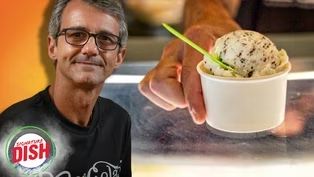
NewDC's Best Gelato Might Be Hiding in the National Gallery of Art's Basement
Video has Closed Captions
Clip: S4 Ep11 | 5m 22s | Seth visits Dolci Gelati at the National Gallery of Art for world class gelato. (5m 22s)
 New
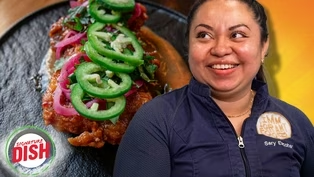
NewImmigrant Food Cafe at Planet Word Turns Recipes Into Advocacy
Video has Closed Captions
Clip: S4 Ep11 | 5m | Seth visits Immigrant Food at Planet Word Museum to sample ilipino fried chicken and pupusas. (5m)
 New
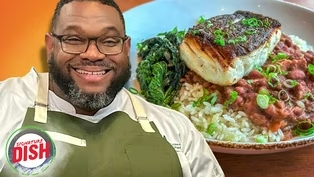
NewSweet Home Cafe Serves Up Some of DC's Best Soul Food
Video has Closed Captions
Clip: S4 Ep11 | 6m 20s | Seth visits Sweet Home Cafe at the National Museum of African American History and Culture. (6m 20s)
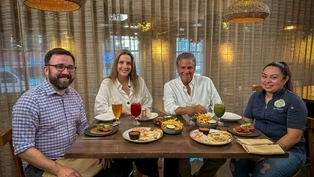
Preview: S4 Ep11 | 30s | Sweet Home Cafe at NMAAHC, Immigrant Food at Planet Word, Dolci Gelati at the NGA (30s)
Providing Support for PBS.org
Learn Moreabout PBS online sponsorship
- Food
Christopher Kimball’s Milk Street Television
Transform home cooking with the editors of Christopher Kimball’s Milk Street Magazine.







Support for PBS provided by:
Signature Dish is a local public television program presented by WETA