
Here and Now
Here & Now for September 25, 2026
Season 2500 Episode 2513 | 26m 45sVideo has Closed Captions
Watch the entire episode of Here & Now for September 25.
Watch the entire episode of Here & Now for September 25.
Problems playing video? | Closed Captioning Feedback
Problems playing video? | Closed Captioning Feedback
Here and Now is a local public television program presented by PBS Wisconsin
Here and Now
Here & Now for September 25, 2026
Season 2500 Episode 2513 | 26m 45sVideo has Closed Captions
Watch the entire episode of Here & Now for September 25.
Problems playing video? | Closed Captioning Feedback
Where to Watch Here and Now
Here and Now is available to stream on pbs.org and the PBS app.
Providing Support for PBS.org
Learn Moreabout PBS online sponsorship>> The following program is a PBS Wisconsin Original production.
>> Colder temperatures settled in across the state as projections see a rise in the cost of heat and.
A state treasurer on Lake Superior is feared to be overrun if turned into a national park.
[MUSIC] I'm Frederica Freyberg tonight on "Here& Now" the Citizens Utility Board on what will help and hurt heating costs this winter.
How Wausau is leading in lead pipe replacement and covering the tab.
A La Crosse program finds success reducing homelessness and whether to preserve the Apostle Islands by opening it to more tourism.
It's "Here& Now" for September 25th.
[MUSIC] >> Funding for Here and now is provided by the Focus Fund for journalism.
[MUSIC] Wisconsin.
>> As temperatures cool down with the advent of winter not far behind, it will soon be time to turn on the furnace.
And like gasoline and diesel prices, the cost to heat your home is expected to go up by an average of about 8.7% for the season, according to national forecasts.
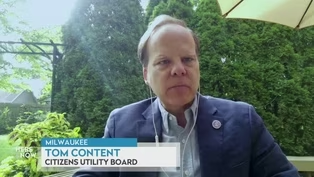
Tom Content, of the Citizens Utility Board has been tracking the trend.
And thanks very much for being here.
>> So is this just like added to the list of the things that are costing more right now?
>> There is so much.
I mean, we we're seeing it everywhere.
And unfortunately, we we had a high heating cost winter last year, in part because of how expensive natural gas was, but mainly because of how frigid the winter was.
We had those stretched double stretches of subzero temperatures that hit us hard.
And so people were firing up their furnaces.
And then the next month, they were looking at their utility bills going, what the heck happened?
Because my prices are off the charts.
And we're concerned that that could that could be a problem again this winter.
>> Speaking of temperatures, though, this El Nino weather pattern could help.
Could be warmer.
It's always kind of not known.
>> No, it's not known.
And we're waiting for the official for an official forecast from the Energy Information Administration won't come out til that next month.
And that one will actually incorporate forecasts as the forecast of temperatures as well.
And the utilities themselves often put out forecasts.
And we're still waiting on that.
But the information we have so far shows, especially for people in rural Wisconsin, that use propane or in areas of the state that still use heating oil, that this could be a tough winter.
>> Because the heating oil price projections put it up more than 30%.
But is that a small number of people who use oil in Wisconsin?
>> Yes it is.
It's a very small amount.
I just looked and it's about 35,000 households across the state that use it.
And this would be a good year to get rid of heating oil because the prices are off the charts, because heating oil is really directly affected by crude oil prices.
Propane is also affected, but not quite as much by crude oil prices.
But it is affected.
>> So propane and electric, I understand, represent about 500,000 households together.
And those price projections are at like about 9%.
Where do people mostly use propane and electric?
Because the what, like 65% of people use natural gas.
>> Correct.
Two thirds of Wisconsin's use natural gas and propane is is the farm.
The rural areas of Wisconsin are often on propane.
Because of the natural gas system hasn't connected them.
And so so a lot of rural Wisconsinites should really reach out to their propane dealers and maybe get multiple quotes this this year just to see what what deal you can get and maybe try to try to lock that in because the prices are are concerning.
But, but there are opportunities to convert to natural gas in some areas now.
And so that that's, that's an option to think about.
>> So you also say that there are other ways that people can potentially save, including through the the program focus on energy.
And that is like legitimate.
>> Yeah, that's a statewide program that everybody pays into who's a utility customer.
Wisconsin pays into focus every year.
And so what we want to see is more people take advantage of focus and get the benefits.
So this is the program that used to provide LED light bulbs to everybody.
And now LED prices have come down so much that focuses focus, provides incentives in other ways.
They actually have incentives.
If you want to add solar to your house, they have incentives on a highly efficient furnace.
They have incentives on insulation and air sealing.
And the biggest thing that and newest thing that they have is they have funding through the Inflation Reduction Act that Congress passed a few years ago.
For a whole variety of programs that help all customers.
But actually there's extra incentives for low income customers that are built into that.
And so people should really take a look at the Focus on energy website w its focus on energy.com.
And there's a really handy get started button on there that you can then enter in your information and even your income, and it'll let you know the kinds of things that you're eligible for.
So that's a really important thing to know.
>> The other thing that you are watching is a price hike on the horizon from some utility companies coming up the start of the new year.
What's that?
>> So both we Energies and Wisconsin Public Service.
So the eastern a lot of the eastern half of Wisconsin are in for rate hikes right in front of the Public Service Commission right now.
Our group, the consumer advocate, is involved in those cases to try to bring down the size of those increases.
And and so we've been vocal on that, trying to target high profits and other issues.
There's a public hearing coming up this Tuesday on Zoom and in green Bay that people could participate in and have a say before those cases are decided.
>> All right.
Tom Content, thanks very much.
Thanks for your work.
>> All right.
Thank you so much.
>> From heat to water.
About 1 in 10 municipal water lines are served by lead pipes in Wisconsin.
Or according to Wisconsin Watch data, more than 145,000 of them lead in drinking water poses serious health risks, especially to children and pregnant women, as no level of lead exposure is considered safe.
While cities and municipalities across Wisconsin are working to remove lead service lines ahead of a 2037 federal deadline, one city in the midst of the work stands out.
The City of Wausau is on track to replace its remaining some 3000 lead lines by the end of 2028.
That's after already replacing about 3500, the City Council Finance Committee just voted to pay 100% of the cost for residents.
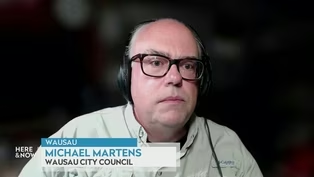
Committee chair Alderman Michael Martins joins us.
And thanks very much for being here.
>> Oh, thank you so much.
Thank you for inviting me.
>> So what is the cost, on average, for residents to replace their lead service lines?
>> Well, it depends on, you know, on on the situation what the composition of their soil is.
We've been averaging about, you know, with, with the, with the current process, about $6,700 per lead service line.
>> And so that's a that's a lot of money for any individual homeowner.
Why did the Finance Committee decide to go ahead and cover that cost?
>> Well, when we looked at the numbers and we saw, you know, we started lead service line replacements in 2024, and we've been very aggressive in moving forward with this, with this program.
And since we've just passed the half way point, we felt that we were we could get as many of these lines done as quickly as we could instead of spreading everything out until that 2037 deadline, we would, you know, even though the upfront cost is more, you know, for us for the next two years, we would we could finish the program by 2028, saving potentially up to $37 million.
And, you know, before the, you know, if we were to if we were to slow our roll.
>> So what is the total cost of the project expected to be when you're finished?
>> I think all in in all done.
It's going to be well over $57 million.
It's and and a significant portion of it.
We've been able to, you know, recover through federal and state grants.
Principal forgiveness loans.
What you know, what we've come up with, you know, is, is as the as the program continues, our funding gap, you know, increases from year to year.
And that's where the city ends up paying more on these last these last three years of the of the replacement program.
>> And isn't it also true that some of these government grants and loans could be drying up as well?
>> You know, they're it's it's part of it is they're drying up.
And other part of it is other communities are coming online with their replacement programs.
So it's the pot is, you know, not only dwindling, but there's more people looking for a share of the of the loans of the principal forgiveness.
You know, we've been fortunate by getting an early start.
We've been able to capture a lion's share of that.
>> So going forward into the next couple of years, as, as you aggressively push to remove these lead lines.
Can the city coffers handle that?
>> I that remains to be seen.
I think, you know, for for at least 2027, I think we are we should be able to, you know, to, to manage it.
What the what the funding gap will be in 2028.
You know, we're still going to have to analyze our debt ratios are at a point where, you know, we can it's it's it, you know, our debt ratios are at the point where we can, you know, we can still manage that.
And I think, you know, you know, we do want to reduce our long term debt, but also, you know, keeping our debt levels, you know, in the future at a, at a manageable pace, you know, is, is also part of that.
>> So.
Meanwhile, the full city council is expected to vote on paying the full cost.
Do you expect that to pass?
>> You know, it remains to be seen.
I think there's, you know, some people that are concerned about what our what our municipal debt level is.
But I think in the long term, this whole, you know, this should win out as a as people see the greater benefits of getting the lead out of our water system and getting this program finished up in a timely manner, you know, so that we can move on.
And in the future, you know, be more be more aggressive with other, you know, other debt reduction programs.
I mean, right now, we've got the ability, you know, to get these loans at a quarter of a percent.
So doing it now saves money later.
We're probably on the leader statewide were the leaders, you know, with with Milwaukee and Racine.
We've been I think we've been fortunate that our previous, you know, mirror, mirror administration really worked hard to secure this funding and to get us, you know, get us set up with this public private partnership that it's really saving a lot of money.
And I hope people see that.
>> All right.
Well, Michael Martens Alderperson, City of Wausau, thanks so much.
>> Okay.
Well, thank you so much.
It's a pleasure to be here.
>> Two years ago, we checked in with the mayor of La Crosse, who was painfully confronting surging numbers of people experiencing homelessness and living in encampments.
In response to the problem, the city, county and local organizations banded together in a concerted effort to get people into housing.
The five year Pathways Home plan launched in 2024, when 300 people were counted as unhoused in La Crosse.
Today, that number is under 200.
The goal to get to a functional zero homeless population by 2029.
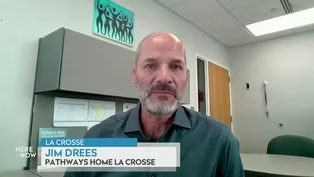
We're joined now by Jim Drees, the La Crosse County Homeless Response Systems Manager and co-lead of Pathways Home.
And thanks very much for being here.
>> So what stands out about how the Pathways Home plan is moving the needle on homelessness in La Crosse?
>> I think we've always had a dozen plus organizations here in nonprofits supporting this community.
What was really critical was just getting alignment.
And so really sharing common information, a by name list of anyone experiencing homelessness, easy ways to get into our system.
And then weekly coordination where we have a dozen plus agencies really working together.
I think just achieving that alignment was, was really important in terms of making a lot of progress.
>> What are the greatest needs and greatest barriers to getting people into housing?
>> Yeah, one of the things we look at with folks is we want to place them into housing that's appropriate for their level of need.
So we'll categorize folks that need anywhere from a light need to moderate, which we consider once a week intensive, which is daily support.
And really in our system, a lot of our reductions in homelessness count have been with those of light and moderate needs, easier to place, easier to house.
Our biggest challenge right now is folks that have intensive support needs.
So daily support, sometimes overnight monitoring, typically related to mental health, trauma, sometimes substance use.
And that's just a shortage in our system.
These tend to be the folks that have been unhoused the longest get categorized as chronically homeless.
And the longer someone is unhoused, the higher their level of need is usually.
>> And so the Pathways Home program includes these kind of wraparound services.
>> Yeah.
So, so really, our goal is developing a wide range of housing and a wide range of support services.
Part of our challenge is a lot of our really good programs, helping folks with mental health, substance use, housing stability issues require a level of stability that often the unhoused population doesn't have.
So we've really extended our outreach into the community.
People don't have to come into our building or into an agency.
We are out almost daily in terms of both general and targeted outreach, because it really takes building trust and connection to help people, you know, get involved in the right programs that lead them to the to appropriate housing.
>> What does functional zero mean?
As stated as a goal by 2029?
>> Yeah.
It recognizes that we won't always be able to prevent someone from becoming unhoused.
But when they do, it's critically important that we get them rehoused quickly.
And so there's two measures that we think about with functional zero.
One, that number of unhoused people in our community should be lower than our ability, our proven ability to house people in a given month.
So right now we're housing about nine people a month.
So we need our count to be under nine.
That would say our system is capable of rehousing them.
And so the target is to rehouse everyone within 30 days.
>> What kind of success have you had in eliminating people living in winter encampments?
>> Yeah.
So really that's where the city and county collaboration comes in, because this is an issue that affects police, it affects parks, it affects fire department, emergency response.
It affects community services.
So City of La Crosse created a camping ban, which really became the catalyst for clearing out encampments.
We are really trying to focus on everyone having a shelter option right now.
We don't have enough emergency shelter beds on there, but we do have extra overnight capacity during the winter.
Recognizing how critical that people have a place to stay overnight when it's cold.
>> What are kind of the benchmark goals between now and 2029?
>> Yeah, it really is reaching functional zero.
And that's taking our count, which is a little under 200 right now, down to say under ten in terms of doing that average duration of homelessness, taking that down to under 30 days up there.
The other thing we had to really adjust in our system was it's not just about getting folks housed.
Once folks are housed historically in our system, unaddressed issues would lead to evictions falling behind on rent, other issues there.
And so really, we've started this housing stability tracker where when people are moved in, we're staying connected.
Who's staying connected?
How are we checking in?
And so really that Housing Stability Tracker would say, you know, the, the best systems in our country right now are tracking at 70 to 80% housing retention after two years.
So it doesn't always work for everyone.
But again, we want to place them in places where they can retain housing, get the support they need.
>> How fulfilling is it to see this movement toward finding this sustainable or stable housing for the unhoused?
>> Yeah, it's it's a mixed bag.
It's hard to celebrate a milestone of going under 200 when you still have people unsheltered in your community on there.
The team is super dedicated in terms of connecting with people.
So, so I do think we take success with each move in.
I remind folks all the time that every number we put out there on our dashboard is connected to a person with a name and a story.
And so we have good days that we celebrate move ins.
We have tough days where there's a remission or someone lost housing.
And so we try to stay steady.
We see ourselves as the backbone of this system, providing consistent options and resources for housing and supportive services.
>> All right.
We leave it there.
Jim Drees.
La Crosse, thanks so much.
>> You're welcome.
>> Finally tonight, what's in a name?
A federal bill authored by Congressman Tom Tiffany to re designate the Apostle Islands from a national lakeshore to a national park is, for some, a practical opportunity to attract more tourists to what would be the first and only national park in Wisconsin.
But there's opposition from local governments, including the Red Cliff band of Lake Superior Chippewa, who stressed their obligation to preserve their homelands.
Reporter Erika Ayisi traveled to Bayfield County to hear how the community feels about the name change.
This report was made in collaboration with Here and Now, and I see Te, formerly Indian country today.
>> As Raspberry Beach is another spot that a lot of bullets Moore right there overnight.
>> The beach is just one of the majestic spots on a cluster of islands off Bayfield, in the northernmost tip of Wisconsin.
They are sacred to the Red Cliff tribal community.
not a play land for us.
>> Nicole Boyd is chairwoman of the Red Cliff Band of Lake Superior Chippewa.
>> We came here as part of a prophecy of the traveling to where the food is on the water.
the Wisconsin side of Lake Superior.
It's 32,000mi!S of the largest freshwater lake in the world.
Known for its pristine waters, historic lighthouses, sea caves, and red sandstone cliffs, the Apostle Islands attract millions of visitors each year.
>> We have an incredible responsibility, and tourism is a part of that.
>> Most of the islands here are a part of the Apostle Islands National Lakeshore.
Tom Tiffany, current congressman for the seventh district, is proposing a bill to redesignate what he calls the crown jewel of Wisconsin.
>> By elevating the Apostle Islands from a national lakeshore to a national park.
We can ensure that thousands more are able to visit this area.
>> Boyd says news of Tiffany's proposal was shocking.
>> First of all, says who?
>> The Red Cliff band maintains hunting rights for tribal members, including the Apostle Islands.
Tiffany says the proposal affirms those treaty rights for all others.
He says even though hunting is not permitted in national parks, it would be on 1 Island.
>> My bill also maintains the heritage of hunting within the Apostle Islands by designating, designating Sand Island, a popular hunting destination as the Sand Island National Preserve.
>> Tiffany says his bill incorporated tribal input on treaty rights.
>> I would also like to note that tribal members were the first to receive any drafts of this bill, and it is from consulting with them and receiving their input that we have included that language.
>> Boyd says the Tribal Council responded to the draft with concerns about the environment, economy and resources.
>> We've never had a meeting.
We've never met as a governing body with Representative Tiffany.
He's never sent his staff here to meet with our team.
>> With the draft resolution, did it mention any financial support to make changes that he propose?
>> Not that we're aware of.
>> Boyd says the Red Cliff Tribal Council was told an increase in tourism would generate revenue.
After the name change.
>> That's what the increase in tourism is going to do.
And the vice chair asking, so the check's in the mail, right?
>> If passed, the Apostle Islands would be Wisconsin's first national park, Boyd says the Red Cliff owns frog Bay Tribal National Park, and it's already a first for the state and the nation.
>> And again, has just felt a little spited that our own representative of our state has not acknowledged.
>> Right behind me is just one of 22 Apostle islands near the Red Cliff band of Lake Superior Chippewa.
Over 4 million people visited these islands and Bayfield County in 2025.
But Bayfield County officials say they also oppose a new national park designation, and they're worried about managing emergency services in this rural community.
>> We're missing calls.
We don't mean to be, but we don't.
We're having trouble manning our EMS.
We're already in a a pretty dire situation.
>> Jan Lee, Bayfield County Board of Supervisors, says about 16,000 people live in Bayfield County, and their tax dollars are responsible for providing emergency services for all visitors.
>> In order to cover that, we have to, you know, raise our levy.
We have to raise the taxes.
>> The National Park Service manages the Apostle Islands National Lakeshore.
Boyd says they are short staffed.
dangerous.
If you are a visitor coming here and we don't have enough law enforcement staff that can respond to an emergency on the lake.
>> Back in Bayfield, Dan Cardinal visits Lake Superior from Wanaka every year and says he supports the bill.
>> Cautiously I do.
I mean, if it guarantees the future of Apostle Islands to continue in the path they've been on for the last 100 years, absolutely.
>> He offers support with caution after reportedly hearing the Trump administration's suggestion to sell some of the nation's parks.
>> The Apostle Islands are not subject to that kind of action right now, and that would make me think like, maybe we shouldn't rush into this.
>> Leave the beauty alone.
>> Christie Branagan is an enrolled member of the Red Cliff band and lives on the reservation.
And she says more tourists might interrupt their ceremonies.
>> A lot of people hold ceremonies down by the water.
Gichi-gami Lake Superior, and with a lot of people coming in tourism, we don't want to be disturbed.
>> Boyd says she doesn't expect people to understand the Red cliffs frustrations with Redesignating, the Apostle Islands.
>> I've heard people say, well, if if the name change isn't the big deal, what's the big deal?
>> She says it's more than a change in name.
>> It is understanding the obligation to protect and preserve this land.
And all the beings here and our water for everyone.
>> In Bayfield.
I'm Eric Ayisi for here and Now.
And I see te.
>> For more on this and other issues facing Wisconsin, visit our website at PBS wisconsin.org and then click on the news tab.
That's our program for tonight.
I'm Frederica Freyberg.
Have a good weekend.
[MUSIC] >> Funding for Here and now is provided by the Focus Fund for Journalism and friends of PBS Wisconsin.
 New
NewAlder Michael Martens on Replacing Wausau's Lead Water Pipes
Video has Closed Captions
Clip: S2500 Ep2513 | 6m 2s | Michael Martens on Wausau's goal to remove and replace lead services lines before 2029. (6m 2s)
 New
NewHere & Now opening for September 25, 2026
Video has Closed Captions
Clip: S2500 Ep2513 | 1m 4s | The introduction to the September 25, 2026 episode of Here & Now. (1m 4s)
 New
NewJim Drees on a Program to Reduce Homelessness in La Crosse
Video has Closed Captions
Clip: S2500 Ep2513 | 6m 39s | Jim Drees on La Crosse's goal of achieving a "functional zero" homeless population. (6m 39s)
 New
NewThe Red Cliff Band and the Future of the Apostle Islands
Video has Closed Captions
Clip: S2500 Ep2513 | 6m 31s | Tribal leaders question a bill to redesignate the Apostle Islands National Lakeshore. (6m 31s)
 New
NewTom Content on Global Energy Prices and Winter Heating Costs
Video has Closed Captions
Clip: S2500 Ep2513 | 5m 38s | Tom Content on spikes in costs of heating fuels as utilities move to hike prices. (5m 38s)
 New
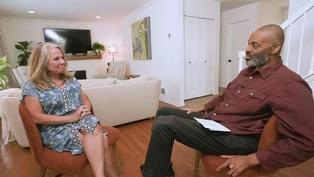
NewIn Focus with Wendi Dwyer: From Disability to Accessibility
Video has Closed Captions
Clip: S2500 Ep2513 | 49m 56s | Wendi Dwyer on work to increase empathy and access for people with disabilities. (49m 56s)
Providing Support for PBS.org
Learn Moreabout PBS online sponsorship New Episode
- News and Public Affairs

Top journalists deliver compelling original analysis of the hour's headlines.
 New Episode
- News and Public Affairs

Today's top journalists discuss Washington's current political events and public affairs.


 New Episode
 New Episode
 New Episode
 Recently Added
 New Episode
 New Episode

 New Episode
 New Episode
Support for PBS provided by:
Here and Now is a local public television program presented by PBS Wisconsin