Prairie Yard & Garden
The Honeyberry Farm
Season 39 Episode 6 | 28m 45sVideo has Closed Captions
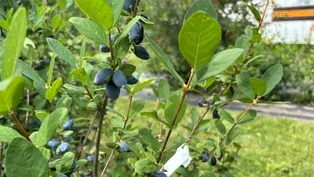
Honeyberries can, in fact, thrive in Minnesota and the Upper Midwest.
What exactly is a honeyberry, and can this unique fruit actually thrive in Minnesota and the Upper Midwest? The answer is a resounding yes! Bernis Ingvalson invites host Mary Holm to her farm, Honeyberry USA near Bagley, Minnesota. Bernis not only confirms that these delicious berries grow beautifully here, but she also opens the farm to the public for picking and sampling.
Problems playing video? | Closed Captioning Feedback
Problems playing video? | Closed Captioning Feedback
Prairie Yard & Garden is a local public television program presented by Pioneer PBS
Production sponsorship is provided by Shalom Hill Farm, Heartland Motor Company, North Dakota State University, Friends of Prairie Yard & Garden, and viewers like you.
Support provided by:


Prairie Yard & Garden
The Honeyberry Farm
Season 39 Episode 6 | 28m 45sVideo has Closed Captions
What exactly is a honeyberry, and can this unique fruit actually thrive in Minnesota and the Upper Midwest? The answer is a resounding yes! Bernis Ingvalson invites host Mary Holm to her farm, Honeyberry USA near Bagley, Minnesota. Bernis not only confirms that these delicious berries grow beautifully here, but she also opens the farm to the public for picking and sampling.
Problems playing video? | Closed Captioning Feedback
How to Watch Prairie Yard & Garden
Prairie Yard & Garden is available to stream on pbs.org and the free PBS App, available on iPhone, Apple TV, Android TV, Android smartphones, Amazon Fire TV, Amazon Fire Tablet, Roku, Samsung Smart TV, and Vizio.

Visit the Prairie Yard & Garden Website
Do you love gardening? Consider becoming a friend of Prairie Yard & Garden to support this show and receive gifts with your contribution. Visit the link below to do so or visit pioneer.org/donate.Providing Support for PBS.org
Learn Moreabout PBS online sponsorship- Over the past many years of doing Prairie Yard & Garden, I have visited with several homeowners and fruit producers who have mentioned honeyberries.
Each time, it was past the season of production, so I have not actually gotten a chance to try a real honeyberry.
I am Mary Holm, and today is finally my chance to try a fresh honeyberry right off the bush and to learn all about producing this lesser-known and newer type of fruit.
- [Announcer] Funding for Prairie Yard & Garden is provided by Heartland Motor Company, providing service to Minnesota and the Dakotas for over 30 years in the heart of truck country.
Heartland Motor Company, we have your best interest at heart.
North Dakota State University through its Field to Fork educational program, providing research-based information on growing, preparing, and preserving fruits and vegetables, Mark and Margaret Yackel-Juleen in honor of Shalom Hill Farm, a non-profit rural education retreat center in a beautiful prairie setting near Windom, Minnesota, and by Friends of Prairie Yard & Garden, a community of supporters like you who engage in the long-term growth of this series.
To become a friend of Prairie Yard & Garden, visit www.pioneer.org/pyg.
(playful music) - Gordon, who is on our Prairie Yard & Garden film crew, was telling me they planted honeyberries in their yard several years ago.
So far, they have not gotten a good harvest, so he was happy to hear about today's program.
Bernis Ingvaldson had reached out to invite us to come to their place called the Honeyberry Farm.
This will be our chance to find out all about growing honeyberries successfully.
Thanks, Bernis, for letting us come to have a very good time.
- I am thrilled that you are coming out to share all the wonderful information that I've gleaned over the last 15 years with the public, because it's a great bush to grow in your backyard as well as a small-scale commercial operation.
- Tell me about your background.
- Well, I grew up in Saskatchewan, Canada, on a mixed grain farm, about five hours north of Minot, North Dakota.
- How and when did the honeyberry farm get started?
- Well, my husband and I initially purchased two and a half acres of pasture land.
All of this was previously pasture land that the owner had rented to another neighbor to run cattle, so when we moved here in 2005, we moved the fence line, and for five plus years, we wondered what are we gonna do with this extra acre and a half.
But in the meantime, got our garden started, and we did a little bit of this and that.
And in 2010, I was looking, you know, to expand things a little bit more, paging through the Jung's garden catalog, and I noticed this berry that I hadn't ever seen before.
And it was a stretch shape, it was oblong, but it was bright blue and such an attractive color and an intriguing shape, and it was Zone 3 cold hardy, so what's there not to like about it?
- [Mary] So, what is a honeyberry?
- [Bernis] A honeyberry is an edible honeysuckle, a blue honeysuckle.
And it's Latin term is Lonicera caerulea.
And caerulea in Latin means blue, and it's in the Lonicera family.
It grows in the wild actually, even up at Big Bog State Park here in northern Minnesota and across Canada in some of the mountainous areas as well.
But it's not very common, and the North American varieties are usually smaller bushes with smaller berries that the critters will find before humans do.
But honeyberries are very vigorous, and so they're very adaptable.
They grow in a wide range of soils, from a pH of, you know, four and a half to five to up to eight and in various types of soils, so a very adaptable plant that we are really happy that we stumbled upon, saw it in that garden catalog and ordered my first two plants.
- So, when should you plant them?
- They are very vigorous and can be planted in the spring or fall.
We like to get them in the ground ideally while they're still dormant so that they'll wake up in their new location.
And in the fall, we ship when they're dormant again, so they don't wake up till spring, but we can stick 'em in the ground anytime prior to freeze up, and then they're all ready to wake up first thing in the spring, and they do wake up really early.
- [Mary] Do they need, like, an acidic type of a soil, or do you need to add acid to the soil?
- Not at all.
Not like blueberries.
They do better in a more neutral soil, but they are adaptable to a wide range, even five or lower, up to eight pH.
- [Mary] Should you plant them in the sun or in the shade, or are they fussy that way?
- Up north here, full sun is ideal.
But they can grow in the shade, but would probably not be as productive.
In southern climates, where you get that intense sun, it's advantageous to have partial shade and also to mulch them real heavily to try and keep the roots cooler.
So we've been sending plants as far south as Georgia.
The later-blooming varieties, they're more acclimated to the warmer zones versus the Siberian ones that are more suited to the northern zones, up to about Zone 4 or 5.
So, we try and help our customers to select appropriate varieties that will cross pollinate with each other and be the most suited to their area.
- [Mary] Are honeyberries native to the United States and Canada?
- [Bernis] Well, yes, the Lonicera caerulea species does grow in various areas, Northern United States, across Canada, and in some of the mountainous areas as well out west, but they are a different cultivar selection than what we have here because the native ones are usually shorter with smaller berries, and these ones have been selected for larger berries, maybe more flavor, and different characteristics.
- Do you have to worry about plant hardiness at all?
- These plants are so hardy, especially the ones from northern Russia, Siberia, they're good down to 50 below.
And so, we've sent plants up to North Pole, Alaska, and, of course, they have a good snow cover there.
So, we have never had any fatalities simply because of it being too cold here.
- How about frost damage when they're blooming in the spring?
- This is one of the unique aspects about honeyberries.
The blossoms are pointed downwards, and they are so tolerant of frost they can withstand several hours of down to, like, 20 degrees Fahrenheit, and they just bounce back.
- [Mary] Bernis, can we learn more about the production aspect of honeyberries either for the home gardener or for commercial use?
- [Bernis] Certainly.
I'd love to show you.
Come with me.
(soft music) - You can enjoy your homegrown produce all year long as long as you preserve it properly.
I love old cookbooks.
I have quite a collection, and here are just a few.
Some of them are quite frayed and taped together.
A while ago, someone gave me a collection of 1940s-era cookbooks.
And while you can use all the recipes safely, the canning recipes are ones that I wouldn't recommend, because, in fact, they have oven canning, which we don't recommend, open kettle canning, which we don't recommend.
So where can you get other canning advice?
Well, certainly the internet, but keep in mind, with the internet, anyone can put anything on anytime.
So, social media can be a bit of a problem in terms of accurate information.
Be aware that your best sources of information are either the National Center for Home Food Preservation or Cooperative Extension.
Your jars are one of your primary types of equipment, and you can keep using these repeatedly as long as the jars are not cracked or chipped.
The threads on the jar from one inch to a half an inch, to a quarter inch tell you how far the headspace will be, the distance from your food to the top of the jar.
You also wanna use the standard two piece canning lids, and these can only be used one time.
The screw band can be used repeatedly.
And I have a couple pieces of equipment.
I have a granite canner, and I also have a more recent electric water bath canner.
Either one is safe to use.
Keep in mind that you want to always use safe canning methods.
This is Dr.
Julie taking you from Field to Fork until next time.
(soft music) - Well, here we are, Mary, with one of the most popular honeyberry bushes, or haskap bushes, worldwide.
This one came out of the University of Saskatchewan breeding program.
It's called aurora.
And while we're a little bit late in the season, there are still plenty of pretty blueberries to admire and examine how they grow.
They grow on year-old woods, so whatever branch grew last year, then this spring, that put out new shoots, and on the new shoots from this year, it puts out little berries.
- [Mary] About how long after planting does it take until you get your first crop?
- [Bernis] Well, if you plant a two-year-old gallon-sized bush, it's gonna still take another three, four years to get anything significant.
A five-year bush is considered pretty close to maturity.
But they do keep growing, and some of them keep growing bigger and bigger.
- Do you have to have more than one variety to pollinate and get a better crop?
- In general, yes.
And each seedling will produce a unique berry, just like humans have two parents and each kid is differently.
So, if we have pollination from two different varieties, then their children would be unique and different.
And that's where the breeding programs come in to try and select the cultivars that are the tastiest, the largest, or whatever features that you're breeding for, disease resistance.
But they're all really disease resistance.
- [Mary] When you plant, how far apart should you plant your plants?
- We planted five feet apart in row, 10 feet apart between rows.
That works quite well for some varieties, but we have some monster varieties that keep growing and growing.
Some of the Russian varieties will span 10 feet wide and get to be eight, nine, 10 feet tall.
Even some of the Japanese varieties, and we'll get maybe not so tall but quite wide.
So fortunately, we can prune and control the size by pruning at the base, and that also helps to rejuvenate the bush after several years.
They don't need a lot of care, but there are ways to control the size.
But it's a good thing to do your research and find out what variety you're gonna get and what space you have even if you're a home gardener or a commercial gardener.
- [Mary] When should you prune?
- Ideally late winter, early spring before they break dormancy.
But honestly, we've pruned any time.
I've pruned in August, we've pruned in the spring, and they are so vigorous they just grow back.
In fact, the row right behind you, we mowed that down, I think it was September, and they came back just fine.
They've grown two feet already this year.
But no berries are produced, because berries are only produced the second year, on second-year wood.
- Do the plants make suckers and get bigger from the bottom?
- This is a great thing for home gardeners because you aren't gonna have suckers popping up in your lawn, you aren't gonna have suckers running underground into your neighbor's lawn, which is even worse.
They are contained.
They will branch out from the crown, but no suckers.
- Okay.
Do you fertilize?
And if so, what do you use?
- That's another great thing about these bushes because I never get around to fertilizing, (laughs) and they seem to be doing quite well.
So the only thing I tell people is if you're gonna fertilize, especially in small plants, be very cautious because they have shallow roots, and over fertilizing can burn the roots.
- [Mary] How about what do you do for weed control?
- Critical the first three, four years.
Competition from your lawn is gonna choke, it's gonna, you know, draw that moisture away and the nutrients from the soil, and it's gonna stunt the plants.
And you want at least, I tell people, three to six-feet diameter weed-free, grass-free around the plant, at least till they get established.
- What are the uses of all your honeyberries?
- What can't you do with honeyberries, Mary?
Anything you would do with any other fruit.
So, of course, eating them fresh right off the bush, nothing better than that.
They freeze well, juice up really well.
The only thing I would say, that maybe you wanna do, is mix them with something like blueberries for a pie because they're so juicy, it's kinda like eating jam.
They are so juicy and so sweet.
So I like to make the jam instead of the jelly because all the flavor is utilized, you know, when you make jam, and the skins are so thin that you don't really, it's not very chewy, and the seeds are so small you are gonna hardly notice them.
- Do these have good nutritional value?
- Extremely.
Antioxidants, vitamin C, it has quite an impressive nutritional profile.
But especially with all the antioxidants and polyphenols, you have a skin that's very dark, you know, blue, indicating that it's high in those, usually high in those.
And then, but inside, there are two berries that are surrounded by skin.
So, each berry is actually a twin that has skin.
So there is more skin surface on these berries than any other berry that I know of.
- [Mary] Bernis, I'd like to know more about how you actually harvest these and also to find out a little bit more about your whole operation.
- [Bernis] Come with me, Mary.
(playful music) - I have a question.
I have red coloration on my crabapple trees.
Is there anything I can do about it?
- Yeah, I'm part of a team investigating best management practices for red star rust, which is perhaps what is on the crabapple's leaf.
We're doing these investigations to help better inform the nursery and fruit industries here in Minnesota.
It was first discovered in Minnesota in 2022, and red star rust affects two unrelated plant hosts, Malus species, which are crabapple and apple, and some very popular species of landscape juniper.
And why are we concerned about red star rust and the landscape?
Well, it does have the propensity to cause premature leaf drop on apples and crabapples, which can reduce the tree's vigor, and for apples, decrease the yield.
And of course, we're concerned about the fruit and flower display in crabapples.
But for junipers, we don't suspect any permanent significant damage.
And what does red star rust look like?
Well, on apples and crabapples, you see a large lesion in midsummer, and this lesion is typically brightly colored in hues of red, yellow, and orange, and it's irregularly shaped, meaning it's not perfectly circular, and sometimes even star-shaped, hence the name red star rust.
And if you turn the leaf over at the end of summer, you see bristles on the underside of the leaves.
And those actually contain spores.
And you can think of spores as fungal seeds that cause infection.
And these are windblown to our juniper hosts where they cause a very small gall or a proliferation of tissue.
And these galls are typically not visible, except in spring when you get warm temperatures and rain.
They produce orange gummy spore masses.
It literally looks like someone has flung orange Jell-O at the plant.
And these spores are windblown back to apples and crabapples completing the disease lifecycle.
And how do we manage this in the home landscape?
First off, make sure you buy healthy, disease-free plants at the nursery or garden center.
Secondly, avoid planting both junipers and crabapples or apples in your own home landscape.
Although spores can travel several miles, there's more likelihood of an infection if they're planted in close proximity to one another.
And then thirdly, you wanna make sure your apples and crabapples are properly pruned to allow for air infiltration inside the canopy so the leaves dry out after a rain event.
And typically, chemical intervention isn't necessary if you have a healthy tree.
It can withstand some level of infection.
- So Mary, take a look at this cultivar.
It's very open, and the berries are very visible.
It's a late-blooming and late-harvesting Japanese variety.
This is a younger plant, so I don't know how tall it's gonna get.
As I said, this is our trial plot and it's not commercially available.
We aren't selling it, but I'm growing it to look at its unique features as each selection, each cultivar is very unique.
Over here, we have a taller variety, well, this is an older plant, but it's also of Japanese genetics, and so one of the characteristics of Japanese plants is that, as I mentioned, later-blooming, later-harvesting, and the berries are quite nicely visible to pick.
But you still want to lift up some of the- Oh, look at this, Mary.
We hit the mother lode there.
This also shows the difference between the bright blue berries that still have the bloom.
You know, berries have a little film on them.
That's why these are lighter colored.
And these ones have been more damaged by the wind and brushed against other branches, so the bloom has been rubbed off of those.
Isn't that interesting?
- It is.
How do you actually harvest these?
- Well, it's just as easy as that.
(Mary laughing) - [Mary] But what about, like, in a big scale?
- [Bernis] Commercially, we would put a catch, something to catch them underneath and then we blow the debris off 'cause there's always gonna be some leaves and twigs that fall down as well.
- [Mary] Then, do you use, like, a tarp or a blanket underneath there to catch them?
- [Bernis] These berries are so soft, when they fall, some of them could squish.
And so, we like to have something that we can wash, a surface that's washable.
- [Mary] About how much do you get for a harvest off of one plant?
- [Bernis] It totally depends on the variety.
Some of them are lower producers at maturity.
You can usually shoot for five pounds.
But then you got berry drops.
So I'd say, if you get three pounds, some of the larger varieties were hitting 10, 12 pounds and up to 20 plus pounds.
But those are the monster bushes.
You probably don't want a monster bush in your backyard.
- [Mary] What is the harvest window?
- [Bernis] Well, the earlier Russian varieties, we would start harvest last week in June here in Zone 3 in northern Minnesota.
In Canada or in higher elevations, as in Montana, that could be pushed back a few weeks depending on their climate and when their last frost is.
But typically, after the flowers are pollinated in early May, it takes about six weeks to reach full ripeness.
So here, in early, well, we're at the 10th of July, we have pretty much finished our early harvest, and the later harvest is in full production.
- What do you use all of the berries for?
- Oh, what don't we use them for, Mary?
You know, fresh eating, we start out with just eating them off the bush and then put them in the freezer and figure out what to do with them later.
They freeze great.
You don't have to spread them out individually like raspberries, but, you know, even a couple inches thick if you put them right in the freezer, families tell me that they just open up the freezer and the kids grab the berries and eat them like mini popsicles.
- [Mary] What do you do with the harvest?
- [Bernis] Well, first of all, we open up our farm for U-pick.
We love to have people come and pick their own berries and take home, and we show them how to harvest a larger quantity, like the shaking method, so that they can fill up their freezer and have berries throughout the winter.
And in addition to the U-pick, we also harvest berries and put in our freezer for sales to small-scale jam operators that might buy a bucket, 25-pound bucket.
We have in the past even harvested larger amounts for local breweries, three, 400 pounds, wineries.
We have been blessed to collaborate with other adventurous companies that wanna try the the product and they've been very happy with it, I must say.
- [Mary] How do people find out about your U-pick operation?
- [Bernis] Facebook is our friend.
When people come out and have such an enjoyable experience, they tend to take pictures and share it.
So, a lot of it is word of mouth.
But we have advertised in local radio, sometimes newspaper, signs out on the street, but a lot of it, frankly, is word of mouth.
- [Mary] Do you have some of the same people come back year after year?
- [Bernis] It is so wonderful to see our summer friends come back year after year, yes, and they bring their friends.
And yeah, it's like a berry family reunion every end of June, July.
- Do you sell honeyberry plants as well as the fruit?
- Well, you know, that's how we got started, Mary, because when I saw and tasted my first honeyberry bush in Canada and came back and told Jim that I'd like maybe a couple hundred bushes and just have a small little side business, a U-pick.
And he asked me how I was gonna pay for it, so I said, "Well, I'll sell some."
What did I know about horticulture?
What did I know about the nursery business?
All I knew is if he bought a whole bunch, then you could buy them cheap and then sell them at a little bit of markup.
So that's what I did the first year.
And then Jim said, "Well, let's bring some more plants down."
So, we started out with 300 berry varieties and two cherries.
And now, our mail order nursery, www.honeyberryusa.com, offers a wide range pretty much we wanna grow any specialty berry that's Zone 3 cold hardy.
We have tart cherries, we have gooseberries, we have currants, even kiwi.
That's kind of my special new thing is, last year we got our first fuzzless kiwi.
There's way more items that you can grow in Zone 3 than raspberries and strawberries.
Our goal is to explore and offer some of these specialty cold-hardy berries.
- Do you have some recommendations for homeowners who would like to get started with growing honeyberries?
- Yes, there are a couple things to keep in mind.
Two different varieties that bloom at the same time, either early, early-mid, or mid-late bloomers, and then keep the grass away and then just have patience.
It's gonna take four, five years really to get decent sized to get a lot of production.
But the second, third year, there's gonna be a few berries you can taste.
- [Mary] If people have questions, is it all right if they contact you for help?
- Very happy to share what I've learned.
'Cause I knew nothing when I started, Mary.
It was, like, nothing, zero.
But it's been the ride of my life, and it's just been so interesting, and people have been so helpful to teach me, and I'm just more than happy to share what I've learned along the way.
- [Mary] So, do you have plans to expand?
- No.
(laughs) Well, maybe.
Maybe just a few of the new varieties we might add to complement our season, to draw out our season, 'cause we focused on the early varieties now, but when people come to pick cherries, they wanna pick honeyberries too.
And if we're out of honeyberries, they're really disappointed.
So, we're gonna have to put in a few more of the later-ripening ones so they aren't disappointed.
- [Mary] This has been wonderful.
Thank you so much for letting us come out and learn.
- [Bernis] You're so welcome.
So glad you came.
(soft music) - [Announcer] Funding for Prairie Yard & Garden is provided by Heartland Motor Company, providing service to Minnesota and the Dakotas for over 30 years in the heart of truck country.
Heartland Motor Company, we have your best interest at heart.
North Dakota State University through its Field to Fork educational program, providing research-based information on growing, preparing, and preserving fruits and vegetables, Mark and Margaret Yackel-Juleen in honor of Shalom Hill Farm, a non-profit rural education retreat center in a beautiful prairie setting near Windom, Minnesota, and by Friends of Prairie Yard & Garden, a community of supporters like you who engage in the long-term growth of this series.
To become a friend of Prairie Yard & Garden, visit www.pioneer.org/pyg.
(playful music)
 New
NewPreview: S39 Ep6 | 30s | Honeyberries can, in fact, thrive in Minnesota and the Upper Midwest. (30s)
Providing Support for PBS.org
Learn Moreabout PBS online sponsorship

- Home and How To

Hit the road in a classic car for a tour through Great Britain with two antiques experts.












Support for PBS provided by:
Prairie Yard & Garden is a local public television program presented by Pioneer PBS
Production sponsorship is provided by Shalom Hill Farm, Heartland Motor Company, North Dakota State University, Friends of Prairie Yard & Garden, and viewers like you.